

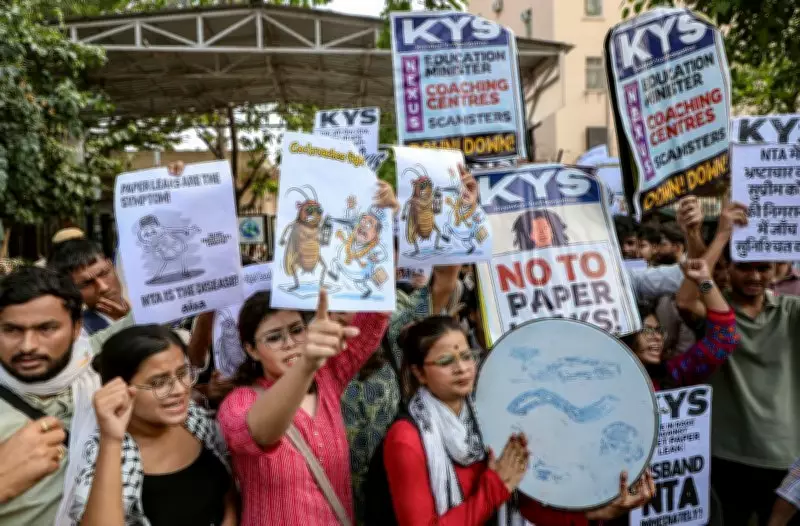
A parliamentary committee has requested the National Testing Agency (NTA) to clearly define what constitutes a 'paper leak' and to disclose whether any such leaks have occurred in examinations conducted since 2018, according to sources.
The move follows an appearance by NTA officials before the panel last week, during which they argued that no paper leak originated from their systems. They claimed that some questions from a guess paper were in circulation, sources added.
Committee Investigating NEET and OSM Issues
The Parliamentary Committee for Education, Women, Children, Youth and Sports, chaired by Congress leader Digvijaya Singh, is examining the NEET paper leak controversy and the CBSE on-screen marking system (OSM) row. The panel has summoned senior government officials, including those from the NTA and the Central Board of Secondary Education (CBSE).

The committee has sought written responses from the CBSE and the NTA regarding the OSM system and the NEET examination, respectively.
Key Questions to NTA
The panel asked the NTA whether it had conducted any inquiry into allegations of irregularities in the NEET-UG 2024 paper, independent of the CBI investigations. Additionally, the committee requested details on the NTA's staff strength over the past three years and any fresh recruitments made since 2022. It also demanded the annual reports submitted by the NTA to the Higher Education Department for the last three years.
Furthermore, the panel sought a detailed report on each of the 101 recommendations made by the Radhakrishnan Committee and the actions taken by the NTA on each point. The high-level committee of experts, led by former ISRO chief K Radhakrishnan, was established in June 2024 to recommend measures for transparent, smooth, and fair conduct of examinations through the NTA, including structural reforms, process improvements, and enhanced data security protocols.
The CBSE has been asked to respond by June 8, while the NTA must submit written answers by June 10. Both agencies have not yet replied, sources said.
CBSE's OSM System Under Scrutiny
The parliamentary panel also questioned the CBSE about reported changes between various Requests for Proposals (RFPs) issued for the OSM system. It asked whether background checks on COEMPT were conducted before awarding the contract. The committee sought to know if the CBSE was aware that COEMPT EduTeck and its directors had prior associations with Globarena Technologies, whose evaluation software was faulted in the inquiry into the 2019 Telangana Intermediate results, and how this influenced the award decision.
Seeking detailed answers, the panel asked why the proviso disqualifying bidders with a past record of poor performance was removed in the third RFP for the OSM contract. It also questioned why the clause prohibiting blacklisted bidders was weakened to exclude only currently blacklisted entities in the third RFP, and why the minimum company turnover was specifically set at Rs 50 crore.
The committee further inquired why RFP provisions were altered from favoring contractors with their own data centres to those using MeitY-empaneled data centres. It asked why the requirement for a robotic scanner was dropped and replaced with a generic provision for 'sufficient scanners', and why the stipulation for contractors to scan answer papers without cutting the spine was removed.
Additionally, the panel sought reasons for reducing the minimum scanning resolution from 300 DPI to 200 DPI in the CBSE's RFP. It also asked why the criterion requiring experience with large projects involving at least 5 lakh students was replaced with a cumulative answer-book volume across multiple projects.
Sources said the panel had previously asked the CBSE to share documents related to the February 2025, May 2025, and August 2025 RFPs for the OSM system, but the board has not complied. The committee also requested the action taken on the report of the observers of the OSM dry run and whether the board shared or discussed the report with the Ministry of Education.






