

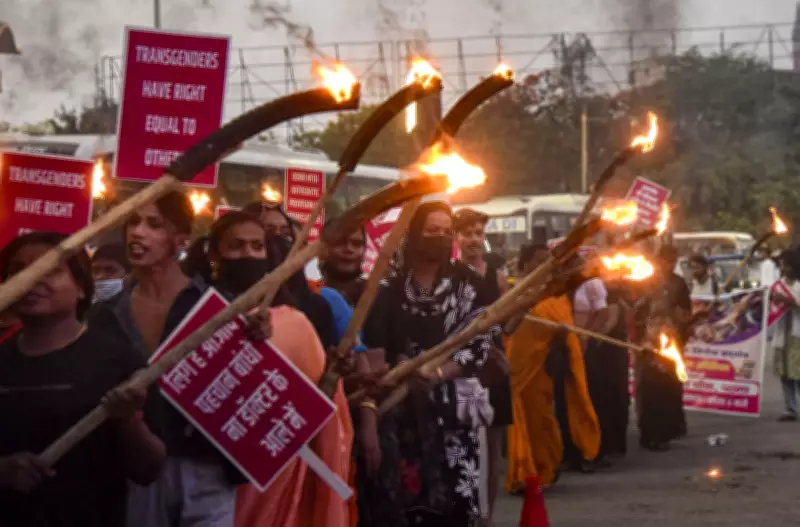
Transgender Activists Stage Torchlight Protest in Patna Against Controversial Law
In a powerful display of dissent, transgender activists organized a torchlight procession at Kargil Chowk in Patna on Wednesday evening. The demonstration was a direct protest against the Transgender Persons (Amendment) Act, 2026, which has sparked significant controversy for its provision mandating individuals to prove their gender identity before a medical board.
Dehumanizing Provisions Spark Outrage
Social worker Vishal Kumar, who participated in the protest, strongly criticized what he described as a dehumanizing provision within the legislation. Kumar emphasized that this requirement fundamentally violates the principle of self-identification, which is considered a cornerstone of transgender rights. "This law forces individuals to undergo unnecessary scrutiny that undermines their dignity and autonomy," Kumar stated during the demonstration.
The activist group has announced concrete plans to escalate their opposition. They intend to submit a comprehensive memorandum to the Prime Minister's Office and other relevant authorities, formally requesting amendments to the contentious law. Additionally, the protesters are preparing to file writ petitions in both the Patna High Court and the Supreme Court, seeking judicial intervention against what they view as unconstitutional provisions.

Legal Challenges and Community Response
Cynthia Mathew, a practicing lawyer at the Patna High Court who joined the protest, brought significant legal perspective to the demonstration. Mathew revealed she is currently handling more than twenty cases related to transgender rights within the city alone. She characterized the legislation as particularly problematic because it was allegedly passed without adequate parliamentary discussion or consultation with affected communities.
"This law represents a regressive step that violates fundamental rights protected under our Constitution," Mathew asserted. "Gender identity should never be subject to external scrutiny or validation. The right to identify as transgender is inherent and personal, not something that requires medical certification."
Firdaus, a prominent member of the transgender community who participated in the torchlight procession, made an impassioned statement about the protest's significance. "We will continue our demonstrations until our rights are fully restored and recognized," Firdaus declared. "Gender identity cannot and should not be determined solely by biological anatomy. This reductionist approach ignores the complex reality of human identity."
Broader Implications and Future Actions
The protest in Patna represents a significant moment in the ongoing struggle for transgender rights in India. The requirement for medical board approval has been widely criticized by human rights organizations as creating unnecessary barriers and perpetuating stigma against transgender individuals. Activists argue that such provisions contradict international human rights standards and progressive legal frameworks that recognize self-identification as a fundamental right.
The torchlight procession at Kargil Chowk served as both a symbolic and practical gathering point for the community. Participants carried banners and placards highlighting their demands while engaging with bystanders to raise awareness about the implications of the legislation. The evening demonstration drew attention from local media and residents, amplifying the community's message across the city.
As the legal challenges move forward, the transgender community in Patna and across India remains determined to advocate for legislative changes. The planned memorandum to authorities and anticipated court petitions represent strategic approaches to addressing what activists describe as systemic discrimination embedded within the law. The protest signals growing organized resistance against provisions that community members believe undermine their dignity and constitutional rights.






