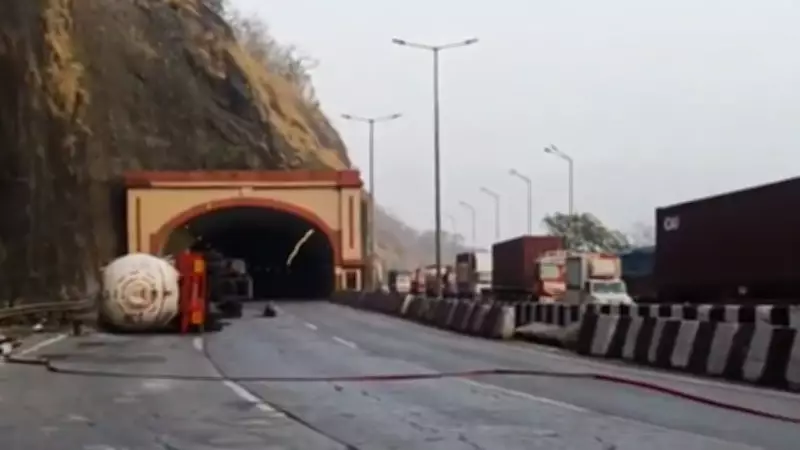
Potentially Catastrophic Propylene Gas Leak Contained After Marathon 32-Hour Operation on Pune-Mumbai Expressway
In a high-stakes operation that stretched over 32 grueling hours, disaster management officials and petroleum experts successfully contained a dangerous leak of nearly three tonnes of highly flammable propylene gas from an overturned tanker near the Adoshi tunnel on the Pune–Mumbai Expressway. The incident, which occurred in a challenging ghat section, had the potential to escalate into a major catastrophe given the volatile nature of the gas and the expressway's status as one of Maharashtra's most critical transportation corridors.
"No Room for Error" in High-Pressure Containment Operation
"This could have transformed into a devastating disaster with even the smallest spark or minor operational error," emphasized Z N Gawade, technical director of Mec Elec Industrial Services (MEIS), the private agency that spearheaded the on-site containment and decanting efforts. The tanker, transporting compressed propylene gas, overturned in the mountainous terrain, damaging its valves and initiating a continuous, dangerous leakage that required immediate expert intervention.
According to petroleum experts involved in the response, the primary challenge stemmed from propylene's extreme flammability, which eliminated virtually all margin for error throughout the prolonged operation. Every action had to be executed with surgical precision under constant threat of ignition.

Favorable Conditions and Strict Protocols Prevent Worst-Case Scenario
Gawade noted that environmental factors played a crucial role in averting disaster. "Fortunately, the incident occurred in a ghat section characterized by strong winds and absence of nearby human settlements. These conditions facilitated rapid dispersion of the leaked gas," he explained. "We rigorously adhered to established standard operating procedures and maintained continuous water spraying in the surrounding area to passivate vapors. This critical step significantly reduced gas concentration and prevented potential ignition."
Officials described the operation as both physically and mentally exhausting, requiring:
- Continuous real-time monitoring of atmospheric gas levels
- Meticulous placement of specialized equipment and personnel
- Seamless coordination among multiple response agencies
- Sustained focus to prevent even momentary lapses over 32 hours
"Every exercise had to be executed in a calculated, controlled manner," Gawade stressed. "We repeatedly reassessed even routine actions due to the constantly evolving situation on the ground."
Maintaining Composure Under Extreme Pressure
MEIS director Madhav Divekar highlighted that maintaining team composure represented one of the operation's most challenging aspects. "This was an intensely tense scenario where panic could have triggered serious consequences," Divekar stated. "We had to sustain the highest level of calm while ensuring every team member's morale remained strong. Despite tremendous pressure, our personnel maintained their composure and worked through exceptionally difficult conditions."
Post-Operation Procedures and Safety Assessments
Following the successful on-site containment, the damaged tanker was transported to Khalapur, where removal of residual gas and further decanting operations continue under strictly controlled conditions. MEIS, recognized as a Competent Inspection and Certification Agency under the Static and Mobile Pressure Vessels Rules 2016 and authorized by the Petroleum and Explosives Safety Organisation (PESO), has prepared the propylene tanker for PESO inspection.
"Our preliminary assessment revealed no inherent flaws in the tanker's design or construction," Gawade clarified. "The damage to the body and valves resulted specifically from the overturning incident." He added that any potential modifications to tanker design or safety fittings would require formal PESO approval, with PESO teams conducting independent assessments to determine if design changes are necessary.
Broader Implications for Hazardous Material Transport Safety
This incident underscores significant risks associated with transporting hazardous materials through challenging ghat sections and heavily trafficked highways. Experts emphasize the urgent need for:

- Sustained emergency preparedness for similar scenarios
- Enhanced specialized response capabilities
- Stricter safety protocols and enforcement
- Continuous training for personnel handling hazardous materials
The successful containment operation demonstrates both the vulnerabilities in current hazardous material transport systems and the critical importance of expert response teams capable of managing high-risk emergencies on vital infrastructure corridors.