Pune Gas Tanker Crisis Exposes Critical Gaps in Maharashtra's Hazmat Response
A dramatic 32-hour operation to neutralize a leaking propylene gas tanker on the busy Pune-Mumbai Expressway has thrown a harsh and unforgiving spotlight on the severe deficiencies within Maharashtra's hazardous materials response system. Disaster management experts and officials involved in the crisis have pointed to a troubling lack of preparedness, specialized manpower, and essential equipment within state agencies.
A Cascade of Failures and Delays
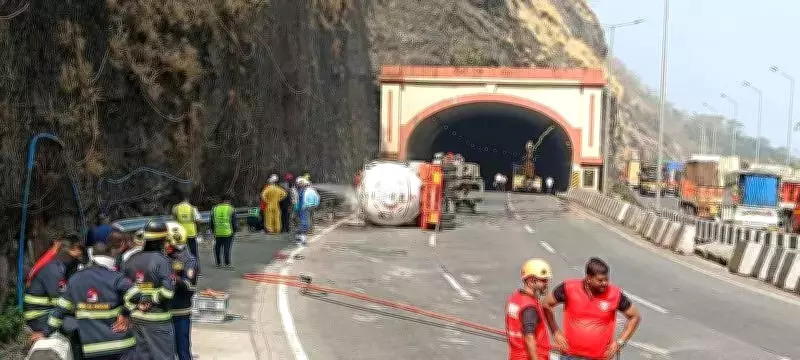
The long and perilous series of events commenced around 5 PM on Tuesday evening when a tanker transporting nearly 21,000 kilograms of highly flammable propylene gas overturned near the Adoshi tunnel. Bhalchandra Chavan, director of the state disaster management department, admitted to significant shortcomings. "We could not operate effectively at the site as we lacked the necessary capabilities and trained personnel for such an environment. We were entirely dependent on private agencies that eventually provided assistance. To manage future emergencies of this nature, we will take essential steps to train our personnel," Chavan stated.
A senior official from the state disaster management unit elaborated on the operational challenges. "With multiple agencies involved and the gas being highly inflammable, we implemented extra precautions to ensure the safety of commuters and personnel. This process consumed additional time, especially since the operation was in the ghat section and faced massive traffic congestion, which hampered our efforts," the official explained.

Critical Hours Lost Without Specialized Response
Despite the extreme gravity of the situation, specialized hazmat response teams did not reach the accident site for several critical hours. Officials confirmed that the operation eventually stretched beyond 32 hours not solely due to technical complexity, but primarily because of significant delays in mobilizing trained hazardous materials experts and the appropriate equipment.
Technical intervention was ultimately led by a private agency, Mec Elec Industrial Services (MEIS), whose team only arrived on Wednesday morning. By that time, propylene continued to escape from the damaged tanker. "This was not a conventional fuel spill. Propylene is a compressed, highly volatile gas. Any incorrect maneuver could have triggered a catastrophic blast," a senior disaster management official emphasized, noting that most state agencies lacked practical experience in such high-stakes scenarios.
On-the-Ground Volatility and Technical Challenges
ZN Gawade, technical director of MEIS, described the on-site situation as extremely volatile and critical. "All three top-mounted ball valves on the tanker were damaged in the rollover and were actively leaking. Liquid propylene was discharging from every connection, forcing authorities to halt traffic in both directions. Lower Explosive Limit readings were alarmingly high even 500 meters from the site, underscoring the severe and imminent explosion risk," Gawade reported.
Working under life-threatening conditions, the response team managed to arrest two out of the three leaks—one liquid and one vapour valve. The third valve, however, presented a formidable challenge. Bent sharply during the impact, its handle jammed against the weld cap, making operation impossible while liquid propylene continued to escape.
High-Risk Decanting Strategy and Multi-Agency Effort
Gawade reached the site on Wednesday morning, travelling against traffic flow in a police-escorted ambulance. After a detailed technical assessment, the team opted for a high-risk decanting strategy—transferring the tanker's contents through the single operable vapour valve into multiple empty propylene tankers. "The objective was to reduce the liquid level inside the damaged tanker until the leaking valve began releasing vapour instead of liquid, significantly lowering the overall hazard," he explained.

Madhav Divekar, director of MEIS, detailed the meticulous process. "By around 4:30 PM, specialized transfer hoses were connected and liquid transfer was initiated using pressure differential, with receiving tankers carefully depressurized. The process was repeated three times, each transfer conducted with extreme caution due to loosened valves and mechanical instability," Divekar said.
Once the leaking valve began venting vapour—indicating the liquid level dropped below roughly 50%—authorities prepared for the next critical phase: lifting the overturned tanker. The operation was executed with extensive multi-agency support, including police, NDRF, fire brigade, and other state and local agencies. Four cranes and multiple fire tenders were deployed, with the plan rehearsed in detail before execution.
Final Stages of a Marathon Operation
"As anticipated, the leak briefly intensified when residual liquid contacted the damaged valve via the dip pipe. The response team swiftly arrested the final leak, preventing a dangerous escalation at a critical moment. At around 1:30 AM on Thursday, the tanker was escorted through the ghat section under strict safety supervision," Divekar recounted.
"Despite still containing a significant quantity of propylene, another delicate operation was undertaken, partially opening the bent liquid valve to decant additional product into a fourth tanker. The tanker was finally transported to the Khalapur tanker testing station, reaching the facility at around 5 AM. By then, the technical team had worked continuously for almost 36 hours, navigating one of the most complex and hazardous compressed-gas response operations witnessed on an Indian highway in recent years," Divekar added.
Urgent Recommendations for Systemic Reform
The incident has sparked urgent calls for systemic reform in India's hazardous materials management framework. Experts propose several critical measures:
- A clearly defined, legally binding Standard Operating Procedure must be established for responding to chemical and gas tanker emergencies.
- The SOP should explicitly spell out the roles of oil companies, district administrations, police, fire brigades, and disaster response teams, along with strict response timelines.
- Petroleum companies, gas refineries, and chemical manufacturers must be mandated to deploy dedicated rescue and recovery vans, equipped specifically to handle compressed gas leaks.
- These specialized units should be strategically stationed along major highways and industrial corridors to ensure rapid response capabilities.
- Movement of highly hazardous gas tankers should be restricted to designated time windows—preferably during low-traffic hours—to minimize public risk and allow quicker isolation of accident sites if required.
- Drivers transporting hazardous materials must undergo compulsory training in emergency response protocols.
- Each tanker should carry a basic emergency kit capable of addressing minor leakages, along with real-time communication systems to alert authorities instantly.
- State governments need to invest in specialized training for fire services, police, and disaster management personnel to handle hazardous material emergencies effectively.
- Regular mock drills on highways and near industrial hubs must be institutionalized to maintain readiness.
The Growing Risk on National Highways
The scale of hazardous material movement across India is staggering and presents a continuous risk. Industry data reveals:
- Nearly 1,000 propylene gas tankers travel daily from refineries in Kochi, Visakhapatnam, Chennai, and Jamnagar, supplying industries across the nation.
- In addition, approximately 4,000 ammonia tankers originate from Maharashtra's industrial hubs such as Taloja and Chembur, moving to southern states and other regions.
Experts warn that while propylene is highly flammable, an ammonia leak would be far more dangerous, releasing toxic gases that could make containment virtually impossible in densely populated or high-traffic areas, potentially leading to a public health catastrophe.
Expert Perspective on National Hazard Management
Amit Bhargava, Co-founder & CEO of Canada-based EnviroApp, a hazmat shipping solutions company, emphasized the national imperative. "India has thousands of hazmat tankers moving daily. Therefore, it is absolutely essential to have designated routes for the transportation of 'dangerous goods' across highways to prevent incidents like this from occurring. Proactive routing and stricter regulations are non-negotiable for public safety," Bhargava stated.
This incident on the Pune-Mumbai Expressway serves as a stark wake-up call, highlighting the urgent need for comprehensive upgrades to India's hazardous materials response infrastructure, training protocols, and regulatory frameworks to prevent future disasters and protect both responders and the public.