

Pune's Modified Bike Silencers: A Public Health Crisis Amid Police Crackdowns
Pune: "It felt like a bomb had gone off right behind me," recalled 62-year-old Sunanda Kulkarni, a resident of Kharadi, describing the moment a motorcycle with a modified silencer sped past her during a recent evening walk. "My heart began racing. For a few seconds, I couldn't even hear properly," she added, highlighting the immediate physical impact of the explosive noise.
Widespread Complaints Across the City
Similar complaints are echoing across Pune, from Hinjewadi's IT corridors to residential lanes in core areas. Parents report toddlers waking up crying in the middle of the night due to sudden loud bursts. Elderly residents experience palpitations and sudden spikes in anxiety, while commuters describe losing balance momentarily when a bike with a "bullet" exhaust roars unexpectedly past them at traffic signals. Pedestrians panic upon hearing the explosive exhaust sounds, often described as "gunshot-like" or "firecracker" noises, creating a pervasive sense of unease in public spaces.
Escalating Police Action and Fines
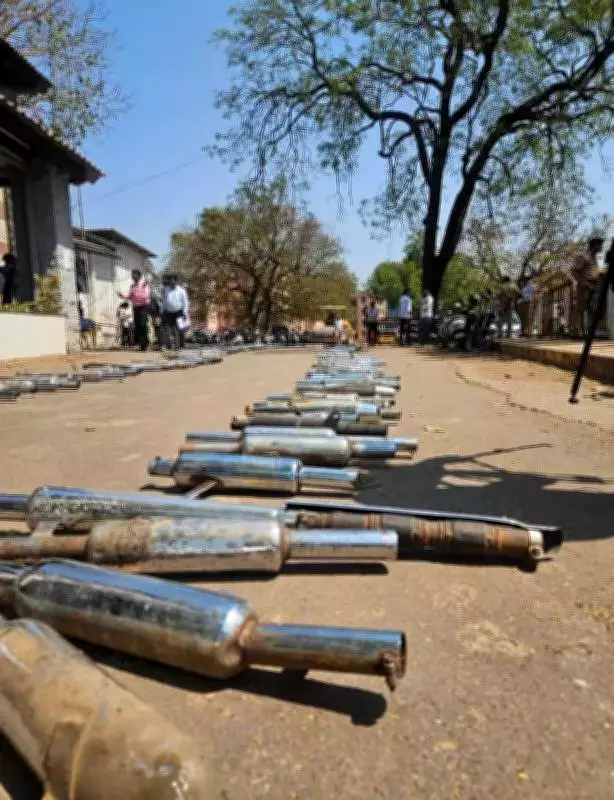
The rampant use of modified silencers has prompted intensified police crackdowns. In 2025, Pune police caught 3,130 offenders, collecting fines totaling Rs 11.25 lakh. The Pimpri Chinchwad police were even more aggressive, apprehending 14,512 violators who paid fines worth Rs 1.44 crore. Despite these efforts, cases continued into 2026.

Recent crackdowns by Pune police in areas like Wagholi, Yerawada, Katraj, Sinhagad Road, and Warje during January-February resulted in 3,764 offenders being caught, with fines amounting to Rs 29.37 lakh. Simultaneously, Pimpri Chinchwad police nabbed 1,853 violators, collecting Rs 18.53 lakh in penalties.
'A Criminal Mindset' and Stricter Legal Measures
Yet, repeated police action has shown limited deterrent effect. Pune's additional commissioner of police (east), Manoj Patil, stated that authorities are now registering cases under Bharatiya Nyaya Sanhita (BNS) sections to send a stern message. "We are also shocked by this mentality. It is no less than a criminal one. These modified silencers generate sound more than 50 times the permissible limit. It is a big menace for people. We will not spare the offenders," he emphasized.
The Science of Sound and Health Risks
Under the Motor Vehicles Act, motorcycles must operate within prescribed noise limits, typically around 80 decibels (dB). However, modified aftermarket silencers, especially on high-torque bikes, frequently produce noise between 90 and 100 dB, sometimes higher when engines are revved aggressively.
"The danger lies in the mathematics of sound itself. The dB scale is logarithmic, so every increase of 10 dB represents a tenfold increase in sound intensity. A motorcycle emitting 100 dB produces 100 times more sound energy than one at 80 dB," explained a senior Automotive Research Association of India (ARAI) official.
The World Health Organization (WHO) considers environmental noise above 55 dB during the day and 45 dB at night as potentially harmful in residential settings. Prolonged exposure to above 85 dB significantly increases the risk of hearing damage. "Such modification needs to be considered a crime," the ARAI official added.
Medical Experts Sound Alarm Bells
Doctors warn of long-lasting impacts across all age groups. A senior Army doctor, speaking anonymously, detailed the consequences: "One of the most direct effects is Noise-Induced Hearing Loss (NIHL). Delicate sensory hair cells in the ear, which convert sound waves into electrical signals for the brain, become overstimulated and die when exposed repeatedly to high-intensity noise. Unlike other cells, they do not regenerate."
Even short bursts of very loud noise can cause temporary hearing loss or tinnitus, a persistent ringing sensation. Moreover, scientific studies over the past two decades have established a link between chronic environmental noise and cardiovascular disease. "When the body hears a sudden loud sound, like an explosive exhaust burst, it activates the 'fight or flight' response. The sympathetic nervous system releases stress hormones such as cortisol and adrenaline, causing heart rate and blood pressure to spike," explained another army doctor.

Residents' Nightly Ordeal
Residents in areas like Wakad and Kalyaninagar report bikes racing past midnight. "You are just about to fall asleep, and suddenly there's a blast. Your heart jumps," said a young IT professional living near a main road in Wakad, illustrating the disruption to daily life and sleep patterns.
Psychological Drivers and Social Media Influence
Psychologists studying risk behavior suggest that loud exhausts often serve as tools of identity projection, with amplified sound signaling power and presence. "They want to show off to the public. They feel that they get attention by blasting sound," said Patil, who has interacted with violators to understand their psyche. "They feel proud and enjoy the fun. Social media has glamorized aggressive revving and explosive backfires, which is a main contributory factor."
Enforcement Challenges and Solutions
Under the Motor Vehicles Act and environmental noise regulations, altering a vehicle's exhaust system to increase noise levels is illegal. However, enforcement faces hurdles as modified parts are easily available online and in informal markets, with costs ranging from Rs 5,000 to Rs 75,000.
Experts argue that alongside policing, sustained public awareness campaigns are needed to highlight health risks rather than framing the issue merely as nuisance control. Deputy commissioner of police (traffic), Pimpri Chinchwad, Vivek Patil, noted, "We recently conducted a special drive against modified silencers, and our staff continues to monitor the situation. We plan another dedicated drive in coming months. Modified silencers are a craze among youngsters largely for attention. We are also filing cases under the Motor Vehicles Act against those who facilitate these installations."





