Rajasthan High Court Orders DNA Test in 'Rarest of Rare' Maternity Dispute
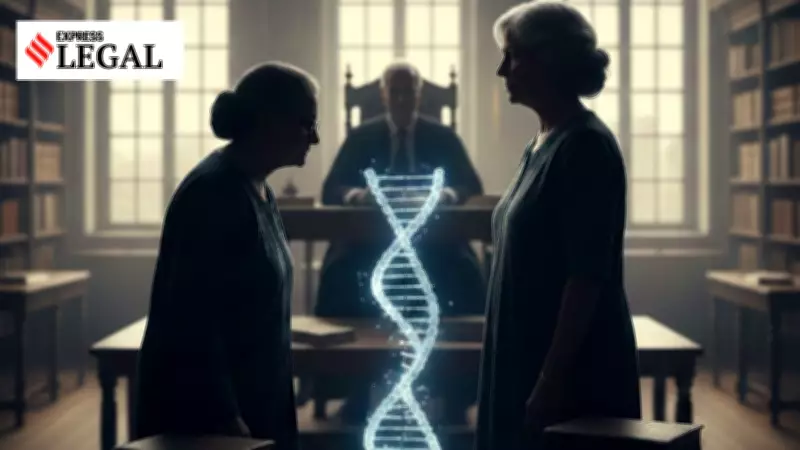
In an extraordinary legal development, the Rajasthan High Court has mandated a DNA test to resolve a property dispute after a 93-year-old woman denied being the mother of the plaintiff. Justice Bipin Gupta described the situation as a "rarest of rare case" while setting aside a trial court's refusal to order the scientific investigation.
The Core of the Property Dispute
The case originated from a civil suit filed by Bhauri Devi, aged 70, who challenged a registered will dated April 10, 2014. This will was allegedly executed by her late father, Shri Badri, in favor of Mahendra Kumar. The disputed agricultural land was claimed as ancestral property, with portions acquired under the Rajasthan State Industrial Development & Investment Corporation (RIICO) Central Spine Scheme. In compensation, Shri Badri received eight plots.
Bhauri Devi asserted that as ancestral property, she and her mother held rights over it. Following Shri Badri's death on January 14, 2017, she became aware of the will on February 17, 2017, prompting her to seek its declaration as null and void while claiming a half share in the property through the civil court.

A Dramatic Turn: Mother Denies Daughter
The case took a startling turn when Bila Devi, approximately 93 years old and the widow of Shri Badri, denied that Bhauri Devi was her daughter. The trial court framed a specific issue regarding whether the plaintiff was indeed the daughter of the deceased. To substantiate her claim, Bhauri Devi filed an application under Order 26 Rule 10A of the Civil Procedure Code, seeking DNA testing for herself and her alleged mother.
However, on February 24, 2022, the additional civil judge rejected this application, citing privacy concerns and the defendants' alleged refusal to undergo testing.
High Court's Groundbreaking Observations
Justice Bipin Gupta expressed astonishment at the rarity of a mother denying her child, noting that society typically sees males disputing paternity. The court emphasized that this case uniquely challenges maternity rather than paternity.
The legislative intent never envisaged a situation where a female would deny that a child was not born from her womb, the court observed. It highlighted the difficulty for a child to prove parentage in today's materialistic world and underscored that advancements in science now allow conclusive determination of both paternity and maternity through DNA testing.
While acknowledging that individuals cannot be forced into paternity or maternity tests, the court clarified that directions for DNA testing can be issued. Refusal to comply may lead to adverse inferences under the Indian Evidence Act of 1872 and corresponding provisions of the Bharatiya Sakshya Adhiniyam, 2023.
Court's Decision and Legal Analysis
Allowing the writ petition, the High Court quashed the trial court's order and directed Bila Devi to undergo DNA testing, with samples to be matched against Bhauri Devi's. Refusal could result in adverse legal inferences.
The court examined Section 112 of the Indian Evidence Act, 1872, and Section 116 of the Bharatiya Sakshya Adhiniyam, 2023, which create presumptions of legitimacy for children born during marriage, primarily focusing on paternity. It noted the absence of statutory presumption for denial of maternity, making scientific evidence crucial in this unprecedented scenario.
Addressing privacy concerns, the court cited Supreme Court precedents, including Dipanwita Roy vs Ronobroto Roy and Nandlal Wasudeo Badwaik vs Lata Nandlal Badwaik, balancing privacy against the pursuit of truth.
Limited Scope of the Order
The High Court declined Bhauri Devi's request for DNA testing of Ramswaroop, who claims to be the son of Shri Badri, stating that he must independently prove his claim. The immediate controversy centered solely on Bhauri Devi's maternity.
This landmark ruling underscores the evolving role of scientific evidence in resolving complex familial and property disputes, particularly in cases defying traditional legal presumptions.