

Rajasthan High Court Issues Correction to Transgender Rights Judgment, Deletes Epilogue Paragraphs
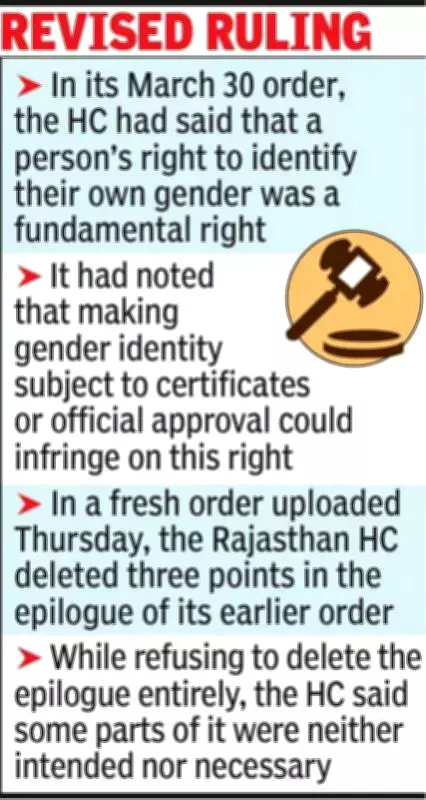
The Rajasthan High Court has made a significant revision to a judgment it delivered just three days prior, concerning the classification of transgender persons under the Other Backward Classes (OBC) category. In a fresh order uploaded on Thursday, a division bench comprising Justice Arun Monga and Justice Yogendra Kumar Purohit deleted three specific points from the epilogue of its March 30 ruling, stating they had been included inadvertently.
Clarification Sought by Petitioner Leads to Court's Revision
The revision came after an application was filed by Ganga Kumari, a 29-year-old transgender individual, seeking clarification regarding the epilogue mentioned in the original judgment. While the High Court refused to delete the epilogue entirely, it acknowledged that certain paragraphs should not have been present. Vivek Mathur, counsel for petitioner Kumari, stated, "The court has clarified and ordered to remove some of the text, which court said came by mistake and was neither intended nor necessary."
Timing Coincides with Parliamentary Action on Transgender Rights
This judicial revision occurred against the backdrop of Parliament passing the Transgender Persons (Protection of Rights) Amendment Bill, 2026, on March 30—the very same day the High Court pronounced its initial order. At the time of the judgment, the bill had not yet become an act, as it awaited the president's assent. However, the president granted assent later that evening, shortly after the High Court's ruling was issued.

Original Observations on Gender Identity and Constitutional Rights
In its March 30 order, the High Court had expressed concerns that "the proposed changes to the Transgender Persons (Protection of Rights) Act, 2019 go against what the Supreme Court had earlier recognised—that a person's gender identity is a basic and fundamental right." The court had warned that making gender identity subject to certificates or official approval could transform this personal right into something controlled by the government.
Furthermore, the High Court had advised the Rajasthan government to formulate policies that respect an individual's right to self-identify their gender to the greatest extent possible and to ensure that new legislation does not undermine constitutional rights. "Any policy should not just follow the law but also protect constitutional values by promoting inclusion, including steps like reservation. Policies should actually improve the lives of transgender persons and reduce the discrimination they face, not just exist on paper," the court had emphasized.
Court Clarifies Intent and Removes Unnecessary Observations
Deeming these points as neither intended nor necessary, the High Court has now clarified, "Be that as it may, the directions in the main judgment were passed as per the prevailing legal position on the date of judgment." The court reiterated that such observations were not essential for deciding the case and have consequently been removed from the epilogue.
The High Court reaffirmed that its original ruling was based on the principles established in the landmark NALSA vs Union of India case, which recognizes a person's right to self-identify their gender as a fundamental right. To ensure accuracy, the court has directed that the earlier version of the judgment be removed from its official website and replaced with the corrected version.
Key Directives from the Original Judgment Remain Intact
Importantly, the core directives from the March 30 judgment remain unchanged. The High Court had instructed the state government to:

- Grant a 3% additional weightage in marks to transgender candidates in government jobs and educational institutions.
- Constitute a high-level committee to study the extent of marginalization faced by transgender persons.
- Recommend a practical and workable reservation framework based on the committee's findings.
These measures aim to address the challenges highlighted in the petition, which challenged a 2023 state notification that classified transgender persons under the OBC category without establishing a distinct reservation framework for them. The court's revision ensures that its legal stance is precise and aligned with the evolving legislative landscape, while still advocating for the rights and inclusion of transgender individuals in Rajasthan.





