Rajasthan High Court Condemns Social Boycott as Unconstitutional Social Evil
The principal seat of the Rajasthan High Court in Jodhpur has delivered a landmark judgment, unequivocally declaring the practice of social boycott and diktats issued by self-styled caste and khap panchayats as a grave social evil. The court has held these practices to be unconstitutional and a direct assault on the fundamental rights of citizens, marking a significant judicial intervention against parallel justice systems.
Court Decries Parallel Justice System Without Legal Authority
A single-judge bench of Justice Farjand Ali issued this powerful order on Friday while adjudicating a batch of 11 petitions originating from districts including Sirohi, Barmer, Jodhpur, Nagaur, Balotra, and Jalore. The petitions detailed disturbing allegations where caste bodies were imposing severe penalties such as social ostracism, exorbitant fines, and causing extensive mental harassment, often with minimal or ineffective police intervention.
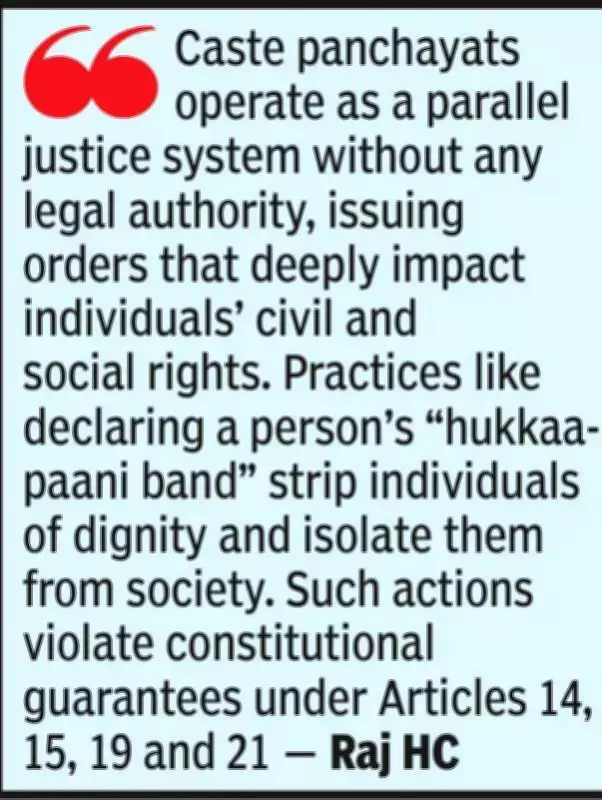
The court meticulously observed that these bodies operate as an unauthorized "parallel justice system," issuing orders that profoundly impact individuals' civil and social rights. Practices like declaring a person's "hukkaa-paani band," which translates to a complete social boycott, were described as mechanisms that strip individuals of their inherent dignity and forcibly isolate them from societal participation.

Violation of Constitutional Guarantees and Fundamental Rights
The bench firmly held that such actions constitute clear violations of constitutional guarantees under Articles 14 (Right to Equality), 15 (Prohibition of Discrimination), 19 (Freedom of Speech and Expression), and 21 (Right to Life and Personal Liberty). The court emphasized that these fundamental rights are non-negotiable and cannot be undermined by extra-legal entities.
Highlighting the critical seriousness of the issue, the court directed the Rajasthan state government to formulate a comprehensive policy and a detailed Standard Operating Procedure (SOP) to effectively address cases of social boycott. This framework must ensure uniform enforcement across all administrative and police authorities. The court further mandated wide dissemination of these guidelines and the implementation of robust public awareness measures to educate citizens about their rights.
Call for Dedicated Legislation and Enhanced Enforcement Mechanisms
The court noted a significant legislative gap, pointing out that Rajasthan currently lacks a specific law criminalizing social boycott. This deficiency forces law enforcement agencies to rely on general provisions like those against extortion, which are often inadequate. The bench strongly recommended that the state enact dedicated legislation, modeled on the Maharashtra Protection of People from Social Boycott Act, 2016, to establish clear punitive provisions and create stronger safeguards for victims.
Issuing further operational directions, the court instructed the Director General of Police (DGP) to appoint a senior officer of at least Additional Superintendent of Police rank. This officer will be responsible for ensuring that all pending cases related to social boycott are investigated fairly and concluded within a strict 90-day timeframe. Additionally, the court ordered the appointment of nodal officers in every district, to be coordinated by district collectors and superintendents of police, alongside the creation of a centralized monitoring mechanism at the state level for oversight and accountability.
Commission Findings Reveal Harsh Realities of Caste-Based Punishments
The court's ruling is substantiated by the findings of a five-member commission it had appointed. The commission reported that such caste bodies routinely punish families for asserting their legal rights, for entering into inter-caste marriages, or for engaging in social reform efforts. The report cited specific, harrowing instances: in one case, a Dalit family was fined Rs 1 lakh and subjected to social ostracism simply for using a horse and band in a wedding procession; in another, a social reformer who opposed the practice of "mrityubhoj" (funeral feast) was penalized with a Rs 5 lakh fine and a complete social boycott.

This comprehensive judgment by the Rajasthan High Court stands as a powerful reaffirmation of constitutional morality and the rule of law, aiming to dismantle oppressive social structures and protect the dignity and rights of every individual against the arbitrary dictates of unauthorized bodies.