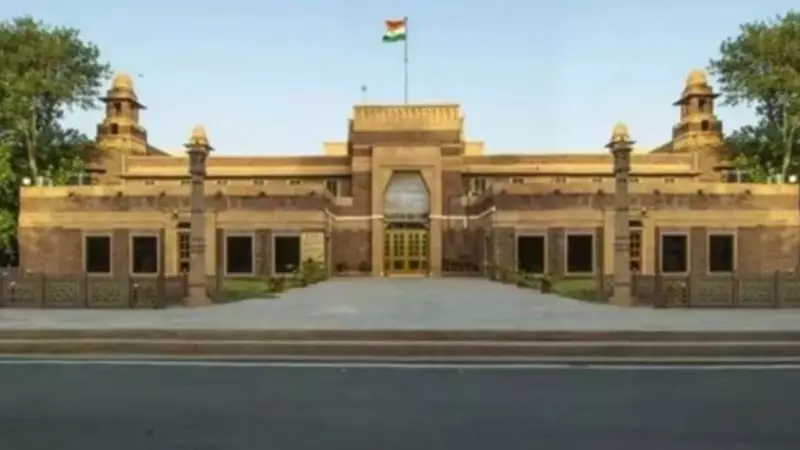
The Rajasthan High Court has firmly upheld the appointment of Padmesh Mishra as the state's Additional Advocate General (AAG), dismissing an appeal that challenged the selection process. A division bench affirmed that the appointment cannot be deemed illegal, arbitrary, unjustified, or whimsical.
Court Rejects Challenge to AAG's Eligibility
The legal controversy began when advocate Sunil Samdaria filed a petition before a single-judge bench. He contested Mishra's appointment on several grounds. The primary argument was that Mishra did not possess the mandatory 10 years of experience stipulated for the AAG post under the state's Litigation Policy of 2018.
Samdaria further alleged that the appointment was made without the effective consultation of the Advocate General, violating Clause 14.2 of the Policy. He also pointed to an eleventh-hour amendment introduced on August 23, 2024, as Clause 14.8, which he argued was crafted to circumvent the experience requirement by allowing appointments based on expertise.

The single bench of Justice Sudesh Bansal dismissed this petition on February 4, 2024. Unsatisfied, Samdaria appealed, contending that the single judge erred in not classifying the AAG office as a public office, given it is remunerated by the government and appointments are made under the Governor's aegis.
Policy is a Guideline, Not a Statute: HC's Key Ruling
The division bench, comprising Acting Chief Justice Sanjeev Prakash Sharma and Justice Baljinder Singh Sandhu, delivered its decisive order on December 2, 2024. In a significant observation, the court clarified the legal standing of the State Litigation Policy.
Citing a Supreme Court order, the bench stated, "Not every kind of policy wields statutory force." It elaborated that the policy acts as a guideline for how the state should function as a litigant. The court noted that the policy's framers did not intend it to be a rigid rule, as evidenced by the continuation of earlier circulars.
"If the State would have wanted to make a rule, it could always make a Rule in terms of Proviso to Article 209 of the Constitution which would have resulted in creation of posts," the HC noted, thereby rejecting the petitioner's claim that the Litigation Policy was legally enforceable in this context.
Art of Advocacy Not Bound by Experience Alone
Given its ruling on the policy's nature, the High Court explicitly declined to examine Mishra's specific eligibility and qualifications. The bench emphasized that it is not within the court's purview to question whom the State Government considers an expert for arguing its cases before the Supreme Court.
In a notable remark, the judges observed, "Art of presentation of a case and art of advocacy is not bound by years of experience." This underscored the court's view that expertise and capability in advocacy cannot be measured solely by the length of one's legal practice.
With this order, the Rajasthan High Court has put an end to the legal challenge, validating the government's decision in appointing Padmesh Mishra as Additional Advocate General and setting a clear precedent on the interpretative scope of government litigation policies.