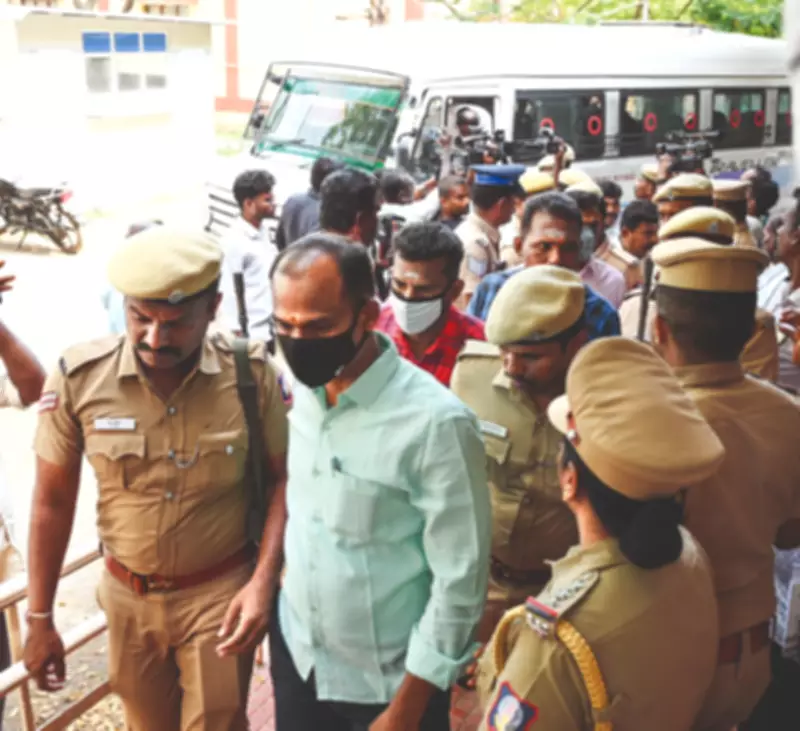
On April 6, nine police personnel were sentenced to death by the Madurai additional district and sessions court for the custodial murder of father and son, Jayaraj and Bennix, in Sathankulam in 2020. The victims, who ran a mobile phone shop, had been detained for allegedly violating Covid-19 lockdown restrictions. Justice was served, said headlines. Was it really?
The Brutal Torture and Death
At the police station, Jayaraj and Bennix were subjected to brutal third-degree torture, including rectal assault with batons, resulting in fatal internal injuries. They were remanded under multiple sections of the IPC and moved to Kovilpatti sub-jail in the early hours of June 20. Bennix died on June 22, his father the following morning at Kovilpatti government hospital. All those convicted were part of the police station personnel, except two constables, Revathi and Beulah Selvakumari, who became crucial eyewitnesses. The court termed the case 'rarest of rare', noting that those entrusted with protecting citizens had committed a crime that 'shook the collective conscience of society'.
Unprecedented Developments
The case brought forth some unprecedented developments in the annals of the retributive justice system in India. Pursuant to the suo motu proceedings initiated by the division bench of the Madurai bench of the Madras High Court comprising Justice P N Prakash (since retired) and Justice B Pugalendhi, in a first, the Tuticorin collector was ordered to depute revenue officials to take over the police station to prevent tampering of evidence and to protect records and other forensic evidence for handing them over to the CBI. Justice Prakash spoke to constable Revathi over WhatsApp while presiding over the bench to instil confidence in her.

Reactions and Defenses
The Supreme Court Advocates-On-Record condemned the act as 'barbaric', and the Indian Police Service (Central) Association called out the atrocities to the victims on X, while its Tamil Nadu counterpart stayed conspicuously tight-lipped. The government flew into a swift defence stating that deaths had occurred due to respiratory failure and heart attack.
Judicial Magistrate's Role
Kovilpatti judicial magistrate M S Bharathidhasan was deputed by the high court to investigate and submit a report directly to the bench. The magistrate was intimidated by ADSP D Kumar, DSP C Pratapan and constable Maharajan, against whom criminal contempt came to be initiated. Subsequent judicial inquiry revealed that all CCTV footage from the night of the torture was deleted. But that did not stop the judicial magistrate who recovered the footage from the hard disk, ensuring that he brought the culprits to book.
The Lingering Question
The verdict is hailed, and rightly so; however, one nagging question in the minds of right-thinking people is whether justice is really seen to be done, in the light of the fact that the magistrate who remanded the victims in police custody without seeing them, and the government doctor who certified the victims as physically fit for remand in spite of severe injuries, still remain unaccountable?
Proviso (b) to Section 167(2), CrPC (Section 187(4), BNSS) requires that the accused be presented before the magistrate at the first instance. Rule 6 of the Criminal Rules of Practice, 2019 also cast a mandatory duty on the judge or magistrate to 'see' if there are injuries on the person of the accused and record all such injuries in the remand order. Sathankulam magistrate Saravanan remanded them in judicial custody without first sending them for medical aid even though the FIR mentioned injuries. The fitness certificate issued by government medical officer Dr Vinila recorded bodily injuries. Her deposition in trial court exposes her negligent conduct in issuing fitness certificate to the victims.
For inexplicable reasons, the victims were taken to Kovilpatti sub-jail, more than 100 km away, instead of the nearest sub-jail in Sathankulam. Kovilpatti prison authorities had also realised something was amiss and recorded the victims' bodily injuries. Still, they admitted them into the sub-jail without referring them for medical treatment.

Magistracy's Responsibility
The magistracy is the judicial limb that acts as the first interface with citizens. A magistrate is conferred with a high degree of responsibility, coupled with the statutory duty of proactively guarding personal liberty and zealously protecting human rights of the detenue. The Supreme Court in Manubhai Ratilal Patel vs State of Gujarat held that directing remand of an accused is fundamentally a judicial function and the magistrate does not act in his executive capacity. In Mohan Lal Sharma vs State of Uttar Pradesh, the SC ruled that a person who is detained by the police cannot be tortured or beaten up. The magistrate in the Sathankulam case did not follow guidelines as laid down in D K Basu vs State of West Bengal to protect rights of the detenue and prevent custodial violence. The magistrate showed scant regard for Article 22(1), which states that a person shall not be arrested or detained in custody without being informed of the grounds for arrest, nor shall he be denied the right to consult a legal practitioner of his choice. He also ignored principles of protection as guaranteed to detenues against torture and arbitrary detention by The Universal Declaration of Human Rights, 1948, and The International Covenant on Civil and Political Rights, 1966.
Shortfall in Justice
For these reasons, the trial court judgment in the Sathankulam case has fallen short of justice being served. The judgment's silence on the dereliction of duty by the magistrate and the careless certification by the government medical officer is haunting. It is puzzling why the trial court judge did not exercise his powers under Rule 116 of Criminal Rules of Practice, 2019, to send a special report to the HC commenting upon the action and inaction of the magistrate in connection with the case.
NGO Arappor Iyakkam and Maja Daruwala, senior advisor to the Commonwealth Human Rights Initiative, had submitted representations to the Madras HC in 2020, seeking action against the magistrate, but it led to nothing. To quote William Shakespeare's Julius Caesar: 'The fault, dear Brutus, is not in our stars, but in ourselves.'
The writer is an advocate at the Madras High Court.