

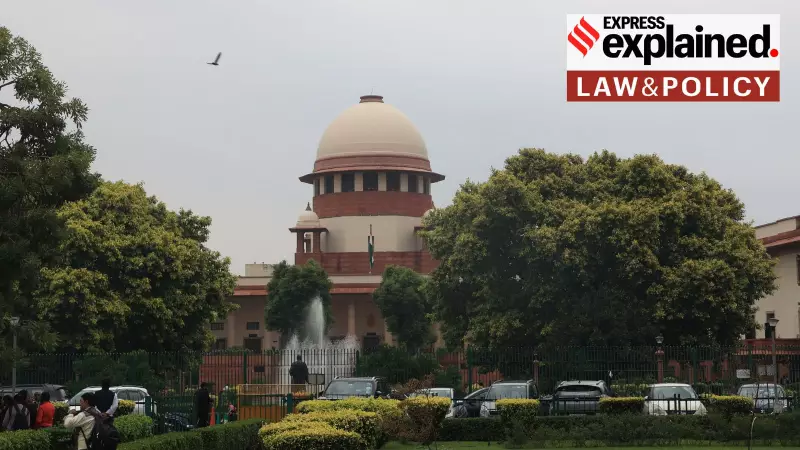
Supreme Court Clarifies Law on Multiple Cheque Bounce Cases
The Supreme Court of India has delivered a significant judgment regarding cheque bounce cases. The court has ruled that multiple criminal complaints can be filed when several cheques bounce, even if they all stem from a single transaction. This decision overturns a previous ruling by the Delhi High Court.
Court Reverses Delhi High Court Decision
A bench comprising Justices Sanjay Karol and Prashant Kumar Mishra made this important clarification. The Supreme Court stated that under Section 138 of the Negotiable Instruments Act, each dishonoured cheque creates a separate cause of action. The court emphasized that the cause of action is linked to the cheque itself, not to the underlying transaction that produced it.
The bench explained their reasoning clearly. "It is well settled that under Section 138 of the NI Act, a separate cause of action arises upon each dishonour of a cheque," the justices noted. They added that the statutory sequence of presentation, dishonour, notice, and failure to pay must be complete for each cheque. The fact that multiple cheques come from one transaction does not merge them into a single cause of action.

The Case That Sparked the Dispute
The legal dispute originated from a failed commercial property deal in Ghaziabad. In November 2016, a buyer named Sumit Bansal agreed to purchase three commercial units in a development project. He paid Rs 1.72 crore as part of this agreement.
The agreement contained specific terms. It stated that if the developer failed to register the sale deeds by September 30, 2018, the entire amount would be refunded with an additional sum. When this deadline passed without registration, the proprietor issued a personal guarantee.
This guarantee involved two parallel sets of cheques. One set came from the firm's account, while another set came from the proprietor's personal account. Both sets were meant to secure repayment of the amount owed.
These cheques bounced repeatedly. The personal cheques were presented first and dishonoured. Then the firm's cheques were presented, and they also failed. Additional cheques presented later for extra amounts were dishonoured on different dates as well.
Each bounce led to a separate complaint under Section 138. Ultimately, five separate cases were filed based on these bounced cheques.
Understanding Section 138 of the Negotiable Instruments Act
Section 138 of the Negotiable Instruments Act establishes specific requirements for cheque bounce offences. The section outlines a fixed sequence that must occur for an offence to take place.
- The cheque must be drawn for discharging a legally enforceable debt or liability
- It must be presented within its validity period
- The bank must return it unpaid, typically with endorsements like "funds insufficient" or "exceeds arrangement"
Section 138(b) provides additional details. When a payee deposits a cheque and it bounces, they have thirty days to demand payment. This demand must be made through a written notice to the drawer of the cheque.
Section 138(c) completes the picture. Upon receiving the notice, the drawer has fifteen days to repay the debt. If they fail to do so, the cause of action arises on the sixteenth day. Only then can the payee file a suit in court.
Commercial Realities and Legal Implications
In commercial transactions, payments are rarely secured by a single cheque. Installments are often split across different dates. Separate cheques frequently cover different components of the same liability.
Businesses commonly issue cheques from company accounts. Promoters often issue personal cheques as additional guarantees. When earlier cheques bounce, fresh ones are sometimes issued in attempts to keep transactions ongoing.
Each of these cheques can independently satisfy the requirements under Section 138. If a cheque is presented on a different date, dishonoured on a different date, followed by its own notice and failure to pay, it creates a separate cause of action. This explains why five complaints followed one agreement to sell in the present case.

Once these elements are shown at the preliminary level, Section 139 of the NI Act comes into play. This section creates a presumption that the cheque was issued for discharging a debt or liability. The complainant does not need to establish the entire financial background at the filing stage. The burden shifts to the accused to rebut this presumption during trial.
The Supreme Court has held on multiple occasions that dishonour alone does not trigger criminal liability. It is the failure to pay after receiving notice that creates the offence. This legal structure explains why cheque bounce cases often outnumber the transactions that give rise to them.
The Delhi High Court's Earlier Intervention
In April 2025, the Delhi High Court took a different view of the matter. The High Court quashed both complaint cases. It held that both sets of cheques related to the same underlying liability - the refund of sale consideration under the agreement to sell.
The High Court reasoned that the personal cheques were issued as a guarantee "in lieu of" the firm's cheques. By presenting the personal cheques first, the complainant was seen to have exercised an option. Following this logic, the firm's cheques should not have been presented later.
Allowing both complaints to continue, the High Court held, would amount to "parallel prosecution" for a single cause of action. The court viewed this as an abuse of legal process.
The Supreme Court's Final Word
The Supreme Court reversed this conclusion completely. The court held firmly that under Section 138, the cause of action is linked to the cheque, not to the underlying transaction. "Each dishonour of a cheque, followed by failure to make payment within the statutory period, constitutes a separate offence," the court stated clearly.
Whether cheques were meant as alternatives, substitutes, or part of a continuing arrangement is a matter for evidence. These questions cannot be settled by reading complaints side by side and drawing conclusions without proper evidence.
A second important issue concerned the scope of the High Court's inherent powers under Section 482 of the Criminal Procedure Code. The Supreme Court reiterated settled law that quashing is permissible only in limited situations. These situations occur when, even if the allegations are accepted at face value, no offence is made out.
The Court held that the High Court exceeded its jurisdiction. It decided disputed questions of fact at the quashing stage, which is not permissible. Whether the personal cheques were issued "in lieu of" the firm's cheques, whether the complainant had exercised an option, or whether liability stood satisfied - all these matters require evidence.
Resolving these questions at the Section 482 stage amounts to conducting a "mini trial." The Supreme Court emphasized that this approach is impermissible under established legal principles.
The court also reaffirmed the operation of Section 139 of the NI Act. This section creates a presumption that a dishonoured cheque was issued for a debt or liability. At the stage of filing a complaint, the complainant is not required to prove liability in detail. The burden lies on the accused to rebut this presumption during trial by leading appropriate evidence.
This judgment provides important clarity for businesses and individuals dealing with cheque transactions. It reinforces the legal framework governing dishonoured cheques while ensuring that each bounced cheque receives separate legal consideration under the law.





