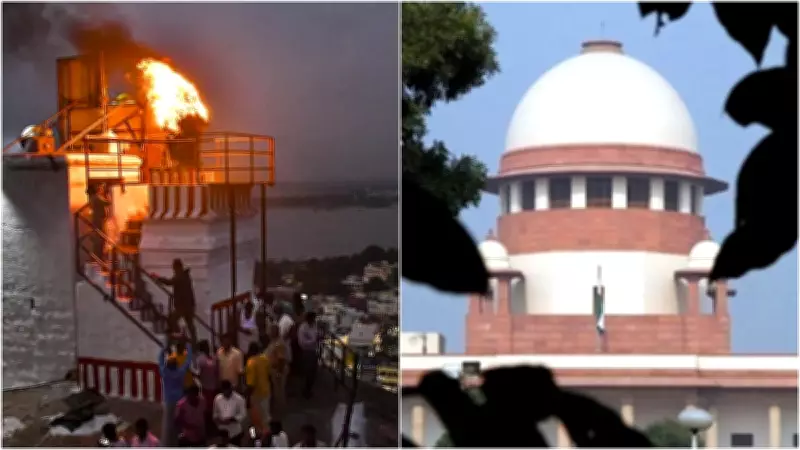
Supreme Court Upholds Madras High Court's 'Balanced' Order on Thiruparankundram Hill
The Supreme Court of India has declined to interfere with a judgment from the Madras High Court concerning religious practices at the Thiruparankundram hill in Tamil Nadu. In a significant ruling, the apex court described the High Court's order as 'balanced', thereby allowing Muslims to offer prayers at the site only during the Islamic festivals of Ramzan and Bakrid.
Details of the Court's Decision
This case revolves around the Sikkandar Badhusha Avuliya Dargah and the Arulmigu Subramania Swamy Temple, both located on the Thiruparankundram hill. The Supreme Court's refusal to intervene effectively upholds the Madras High Court's earlier judgment, which had set specific conditions for prayer offerings at this historically significant location.
The court emphasized that the High Court's approach was measured and fair, aiming to maintain communal harmony while respecting religious sentiments. By limiting Muslim prayers to the periods of Ramzan and Bakrid, the order seeks to balance the rights and practices of different religious communities using the hill.

Implications for Religious Practices
This ruling has several key implications:
- Restricted Prayer Times: Muslims are permitted to offer prayers at the Thiruparankundram hill only during the holy months of Ramzan and the festival of Bakrid.
- Judicial Endorsement: The Supreme Court's characterization of the order as 'balanced' provides a strong judicial endorsement of the High Court's reasoning.
- Precedent Setting: This decision may serve as a precedent for similar cases involving shared religious spaces across India, highlighting the judiciary's role in mediating such sensitive issues.
The Supreme Court's stance underscores the importance of judicial restraint in matters where lower courts have already provided a well-reasoned and equitable solution. By upholding the Madras High Court's order, the apex court has reinforced the principle of maintaining peace and order in multi-religious settings.
This development is closely watched by legal experts and community leaders, as it reflects the ongoing efforts to navigate the complex interplay of religious freedom and public order in India's diverse societal fabric.