

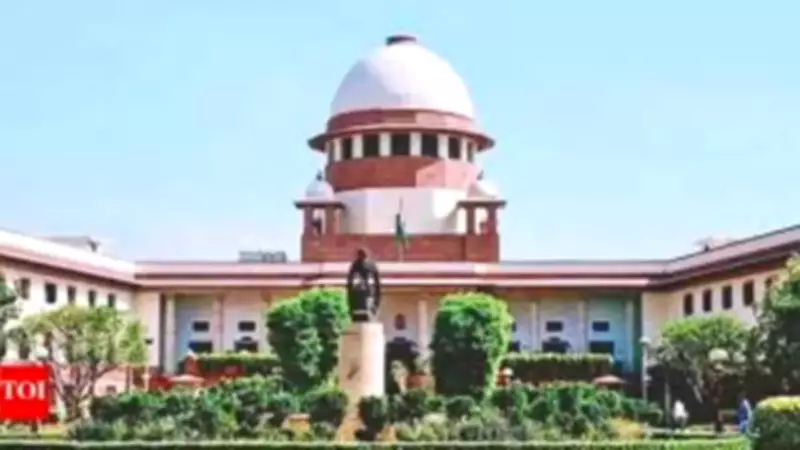
Supreme Court Clarifies Legal Status: Discharge Holds Higher Pedestal Than Acquittal
The Supreme Court of India has delivered a landmark ruling, emphasizing that the discharge of an accused in a criminal case stands on a "better footing" than an acquittal. In a significant judgment, the court declared that no disciplinary or administrative action can be initiated against a person who has been discharged, effectively busting the myth that such individuals continue to bear the label of being accused unless fully acquitted.
Dispelling Legal Fallacies: The Court's Rationale
A bench comprising Justices Dipankar Datta and K V Viswanathan articulated that the common understanding of law in this regard is fundamentally flawed. The bench stated, "It is not the law that an accused, unless he is acquitted, must still carry the label on his forehead that he is accused of a criminal offence." This clarification aims to rectify misconceptions that have persisted in legal and administrative circles.
The court elaborated that once an accused has been discharged, they are entitled to avail all benefits that are otherwise available to an acquitted person. Importantly, the discharged individual cannot be placed in a less advantageous position, ensuring equal protection under the law. This ruling reinforces the principle that discharge should not be viewed as a lesser outcome but rather as a definitive legal status.

Understanding the Distinction: Discharge vs. Acquittal
The Supreme Court provided a detailed explanation of why discharge is considered superior to acquittal in certain contexts. Acquittal typically occurs at the end of a trial process, and it may result from various factors such as technicalities, benefit of doubt, or the prosecution's failure to prove the charges beyond reasonable doubt. In contrast, discharge represents a pre-trial termination of proceedings due to a lack of evidence.
The bench highlighted, "When an accused is discharged, it means that there are no materials to justify the launch of a criminal trial against the accused." This critical distinction underscores that discharge signifies an absence of sufficient evidence from the outset, whereas acquittal involves a judgment after evidence has been presented and evaluated.
Legal Implications and Precedents
Referring to previous Supreme Court verdicts, the bench reinforced that discharge is not merely a procedural step but a substantive legal determination. "Discharge is a pre-trial termination of proceedings for lack of evidence. As and when ordered, discharge signifies and reinforces the position that there is no material against the accused for him to stand trial," the court stated.
This ruling has far-reaching implications for individuals who have been discharged in criminal cases. It ensures that they are not subjected to ongoing stigma or administrative penalties, aligning with the broader principles of justice and fairness. The decision serves as a reminder that legal processes must respect the rights of individuals at every stage, from investigation to trial.
Key Takeaways from the Judgment
- Discharge in a criminal case is legally superior to acquittal in terms of protecting the accused from further action.
- No disciplinary or administrative measures can be taken against a discharged person, mirroring the protections afforded to acquitted individuals.
- The court dismissed the misconception that discharged persons remain labeled as accused, emphasizing their right to move forward without legal hindrances.
- This judgment aims to standardize the treatment of discharged individuals across legal and administrative frameworks, promoting consistency and equity.
In summary, the Supreme Court's ruling provides much-needed clarity on the legal status of discharged accused persons, affirming their rights and challenging outdated perceptions. By placing discharge on a higher pedestal than acquittal in specific contexts, the court has strengthened the safeguards for individuals entangled in the criminal justice system, ensuring that justice is not only done but seen to be done.






