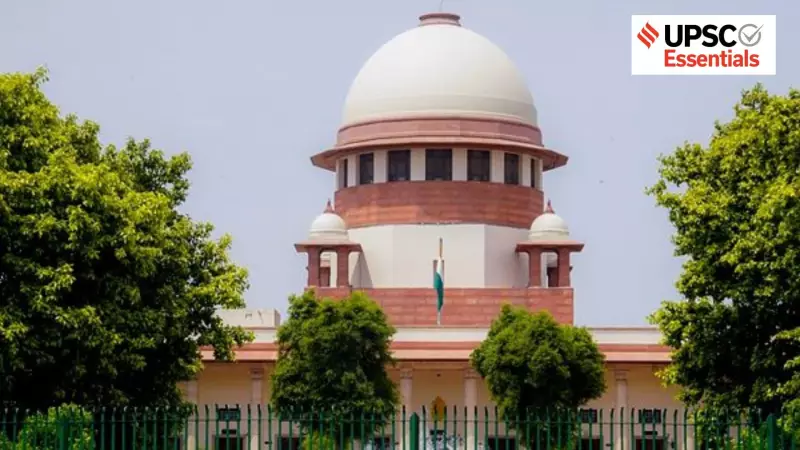
The Supreme Court of India has once again brought the foundational constitutional doctrine of the separation of powers into sharp focus through its recent interventions. On January 5, 2026, the apex court questioned the Uttarakhand government over its failure to act against encroachment on thousands of hectares of forest land. This follows a significant ruling in November 2025, where the Court struck down key provisions of the Tribunals Reforms (Rationalisation and Conditions of Service) Act, 2021, deeming them unconstitutional and a violation of judicial independence and the separation of powers.
The Bedrock of Constitutional Government: Theory and Origins
The principle that power must be distributed, not concentrated, is now a cornerstone of modern democratic governance. This theory is famously traced to the French philosopher Montesquieu and his 1748 work, The Spirit of the Laws. He argued that accumulating legislative, executive, and judicial powers in the same hands is a recipe for tyranny. This idea finds a powerful echo in the words of British historian Lord Acton: “Power tends to corrupt and absolute power corrupts absolutely.” The core belief is that separating government functions into three co-equal branches—the legislature, the executive, and the judiciary—protects citizens from overreach by any single authority.
Separation of Powers in Action: Presidential vs. Parliamentary Systems
The application of this theory differs across the world's major constitutional models. In the American Presidential system, a strict separation exists. The President and the Cabinet are not members of the Congress, creating a clear divide. This system, however, can sometimes lead to gridlock, as seen in the 43-day US government shutdown from October 1 to November 12, 2025, when the legislature refused to sanction executive expenditure.
In contrast, the British Parliamentary system, which India follows, features a fusion of powers. The executive (the Prime Minister and Cabinet) is drawn from and remains accountable to the legislature (Parliament). While some argue this blurs separation, proponents believe it ensures tighter legislative oversight over the executive. Interestingly, a trend of “presidentialisation” of the Prime Minister's office has been noted in the UK, raising concerns about executive dominance.
Checks, Balances, and the Guardian Judiciary
The separation of powers cannot function without its essential companion: the system of checks and balances. This mechanism ensures each branch can limit the others, maintaining equilibrium. In the US, the President can veto legislation, while the Vice President chairs the Senate. In India, the Vice President chairs the Rajya Sabha.
The judiciary, particularly the Supreme Court, plays the pivotal role of the constitutional guardian through judicial review. The Indian Supreme Court's November 2025 ruling on the Tribunals Act is a prime example. The bench, led by Chief Justice B R Gavai and including Justice K Vinod Chandran, objected that the law gave the Union executive excessive control over tribunal appointments, tenure, and salaries, undermining judicial independence.
The Court noted the Act was a “repackaged version” of a prior ordinance and amounted to a “judicial override” of its own 2021 judgment. Crucially, the bench reaffirmed that judicial review is a basic feature of the Indian Constitution, stating, “The Constitution is what the Court says it is... as a necessary corollary of the Court’s role as the final arbiter of constitutional meaning.”
These recent events underscore a timeless constitutional truth: distributing authority and instituting robust checks are not mere legal formalities but vital safeguards for democracy. They operationalize the warning against absolute power and ensure that no single branch of government becomes overwhelming.