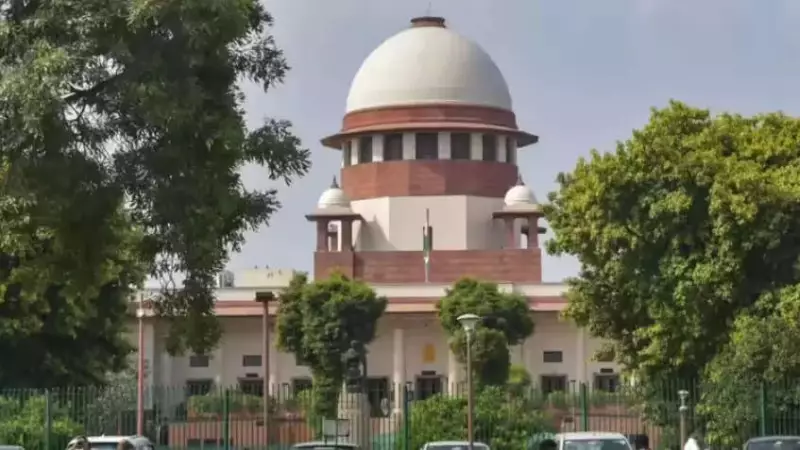
Supreme Court Examines Petition on Brahmins as Politically Backward Classes for Panchayat Reservations
In a significant legal development, the Supreme Court of India is currently examining a petition that questions whether Brahmins, who are traditionally considered socially and educationally advanced, can be classified as politically backward classes (PBCs) entitled to reservation of constituencies in panchayats. This issue has sparked a debate on the intersection of social status and political representation at the grassroots level of democracy.
Petition Details and Legal Arguments
The petition was filed by the NGO 'Youth for Equality Foundation', represented by senior advocate Gopal Sankaranarayanan. It was presented before a bench comprising Chief Justice Surya Kant and Justices R Mahadevan and Joymalya Bagchi. The petitioners argued that despite Brahmins being perceived as socially and educationally forward, they have minimal presence among elected representatives in local governance bodies, such as panchayats.
The legal basis for this argument stems from a 2010 ruling by a five-judge Supreme Court bench in the K Krishna Murthy case. In that judgment, the court explicitly stated that "social and economic backwardness does not necessarily coincide with political backwardness." This precedent suggests that communities might be disadvantaged in political representation even if they are not socially or educationally backward.

Court's Preliminary Observations
During the hearing, the bench expressed its willingness to examine the issue in detail. However, the judges prima facie indicated that politically backward classes (PBCs) should ideally be identified from within the socially and educationally backward classes (SEBCs). The bench remarked, "If those among SEBC communities are under-represented...then they could be categorised as PBCs, but the reverse is not true." This observation highlights the court's initial stance that political backwardness should be linked to social and educational disadvantages.
Historical Context and Legal Framework
The 2010 Supreme Court judgment in the K Krishna Murthy case provided crucial guidance on this matter. The five-judge bench had advised state governments to reconfigure their reservation policies. Specifically, the court noted that beneficiaries under Articles 243-D(6) and 243-T(6) of the Constitution, which deal with reservations in panchayats and municipalities, need not necessarily align with the Socially and Educationally Backward Classes (SEBCs) as defined under Article 15(4) for educational reservations or Article 16(4) for job reservations.
This legal framework allows for a nuanced approach where political backwardness can be assessed independently of social and educational status. The petition leverages this to argue that Brahmins, despite their social advantages, might qualify as PBCs due to their under-representation in elected panchayat positions.
Implications and Broader Debate
The case raises important questions about the criteria for determining political backwardness in India's reservation system. Key points include:
- The distinction between social, educational, and political backwardness as recognized by the Supreme Court.
- The potential for communities with social privileges to still face political marginalization at the grassroots level.
- The impact of such classifications on reservation policies in local self-government institutions.
If the court rules in favor of the petition, it could set a precedent for re-evaluating how political backwardness is defined, potentially extending reservation benefits to groups not traditionally considered backward. Conversely, upholding the bench's preliminary view would reinforce the link between social and educational backwardness with political representation.
This legal battle underscores the ongoing evolution of India's reservation policies, balancing historical injustices with contemporary realities of political participation. The Supreme Court's final decision is awaited with keen interest, as it could reshape the landscape of panchayat reservations and the broader discourse on equality and representation in Indian democracy.