Supreme Court Delivers Landmark Ruling on Hindu Marriage Validity
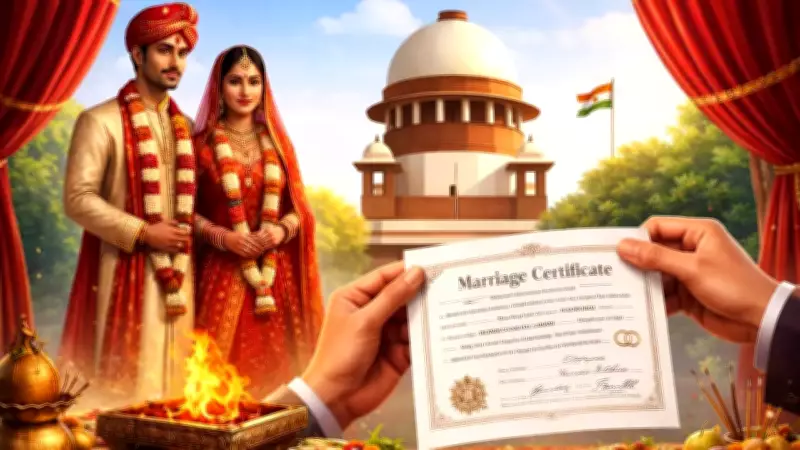
In a significant judgment that clarifies the legal essence of Hindu matrimony, the Supreme Court of India has firmly established that a marriage certificate by itself cannot create the status of husband and wife under Hindu law unless the essential ceremonies are actually performed. The ruling, delivered on April 19, 2024, emphasizes that without traditional rituals, marriage registration remains legally meaningless.
Case Background: Dolly Rani vs. Manish Kumar Chanchal
The judgment emerged from the case Dolly Rani v. Manish Kumar Chanchal, where both parties were trained commercial pilots. They became engaged on March 7, 2021, but instead of immediately conducting a traditional Hindu ceremony, they obtained a marriage certificate from a private organization called Vadik Jankalyan Samiti (Regd.) on July 7, 2021. Subsequently, they used this certificate to register their marriage officially in Uttar Pradesh.
The families had scheduled the actual Hindu wedding ceremony for October 25, 2022. However, before this could occur, serious disputes arose between the couple. The petitioner-woman alleged dowry demands from the respondent-man and his family, leading her to file an FIR on November 17, 2022, under various sections of the Indian Penal Code and the Dowry Prohibition Act.

In March 2023, the respondent-man filed for divorce in the Family Court at Muzaffarpur, Bihar, under the Hindu Marriage Act. The petitioner-woman then approached the Supreme Court seeking to transfer the divorce case to Ranchi, where she resided with her parents.
During the proceedings, both parties reconsidered their positions and jointly applied under Article 142 of the Constitution, requesting the Court to declare that no valid marriage had ever taken place and to quash all related legal proceedings.
Legal Submissions and Court's Analysis
The counsel for the petitioner argued that there was never a valid Hindu marriage, making the divorce petition legally unsustainable. The respondent's counsel admitted that no ceremonies under Section 7 of the Hindu Marriage Act were performed but cited the existence of the marriage registration certificate as the reason for filing the divorce petition.
Both parties collectively submitted to the Court that they had never undergone any Hindu rituals, customs, or rites. They confessed that external pressures and practical considerations led them to obtain the certificates, and they now wished to avoid the legal burdens of a marriage that never truly occurred.
Supreme Court's Detailed Examination
The Bench, comprising Justice B.V. Nagarathna and Justice Augustine George Masih, conducted a thorough analysis of the Hindu Marriage Act, 1955, focusing on Sections 7 and 8. The Court made several crucial observations regarding the nature of Hindu marriage.
Meaning of "Solemnization" Under Section 7
The Court highlighted that Section 7 incorporates the term solemnized, which inherently involves conducting ceremonies. It clarified: "Unless and until the marriage is performed with appropriate ceremonies and in due form, it cannot be said to be 'solemnized'."
The Bench emphasized that Hindu marriage is not a contract but a sacrament (samskara), with rituals like Saptapadi—the seven steps taken in the presence of a sacred fire—being fundamental to its completion. "In the absence of any solemnization of a marriage as per the provisions of the Act, a man and a woman cannot acquire the status of being a husband and a wife to each other."
Furthermore, the Court observed that a certificate issued by any entity, without proof of rituals, cannot establish marital status under Hindu law.
Role of Registration Under Section 8
Regarding Section 8, which regulates marriage registration, the Court made it clear that registration does not create a marriage but merely serves as evidence of a valid marriage. The judgment noted: "If there has been no marriage in accordance with Section 7, the registration would not confer legitimacy to the marriage."
Thus, registration is evidentiary, not constitutive. Without the foundational ceremony, registration holds no legal effect.

Addressing Contemporary Trends and Cultural Significance
The Bench expressed concern over an increasing trend where young couples obtain marriage certificates for practical purposes, such as visa applications or convenience, without performing actual ceremonies. The Court lamented this practice, stating: "In recent years, we have come across several instances where for 'practical purposes', a man and a woman with the intention of solemnisation of their marriage at a future date seek to register their marriage under Section 8 of the Act on the basis of a document which may have been issued as proof of 'solemnisation of their marriage' such as in the instant case."
The Court posed critical questions: "What would be the consequence, if no such marriage is solemnised at all at a future date? What would be the status of the parties then? Are they husband and wife in law and do they acquire such status in society?"
Answering these, the Court underscored the cultural and spiritual significance of marriage in Hindu law, describing it as a solemn institution foundational to family and society. "A Hindu marriage is a samskara and a sacrament which has to be accorded its status as an institution of great value in Indian society. Therefore, we urge young men and women to think deeply about the institution of marriage even before they enter upon it and as to how sacred the said institution is, in Indian society."
The judgment further clarified that while the Special Marriage Act allows couples of any faith to marry through registration and formal procedures, the Hindu Marriage Act specifically requires ceremonies in addition to statutory conditions. Thus, what suffices under the Special Marriage Act does not automatically apply under the Hindu Marriage Act.
Court's Final Ruling and Implications
After considering the joint application and the legal position, the Supreme Court declared: "The 'marriage' dated 07.07.2021 between the parties is not a 'Hindu marriage' having regard to the provisions of Section 7 of the Act."
Consequently, the Court held both the private certificate and the government registration void, affirming that the parties had never become husband and wife. In light of this declaration, the Court quashed all pending proceedings, including the divorce petition in Muzaffarpur, the maintenance case in Ranchi, the criminal FIR, and related proceedings. The transfer petition was disposed of as infructuous.
This landmark ruling reinforces the sacred nature of Hindu marriage and serves as a caution against bypassing essential ceremonies for mere convenience, ensuring that legal formalities align with cultural and spiritual tenets.