In a significant development, the Supreme Court of India has overturned a Bombay High Court directive for a Central Bureau of Investigation (CBI) probe into a major alleged financial fraud. Instead, the apex court has ordered the formation of a Special Investigation Team (SIT) to investigate claims of fund siphoning at the Nirmal Multi-State Credit Co-operative Society, which operates in Maharashtra and Madhya Pradesh.
From CBI to SIT: The Supreme Court's Rationale
A bench led by Chief Justice of India Surya Kant and comprising Justice Joymalya Bagchi delivered the verdict on Monday. The court was hearing appeals filed by the Society's directors challenging a November 20 order from the Nagpur bench of the Bombay High Court that had mandated a CBI investigation.
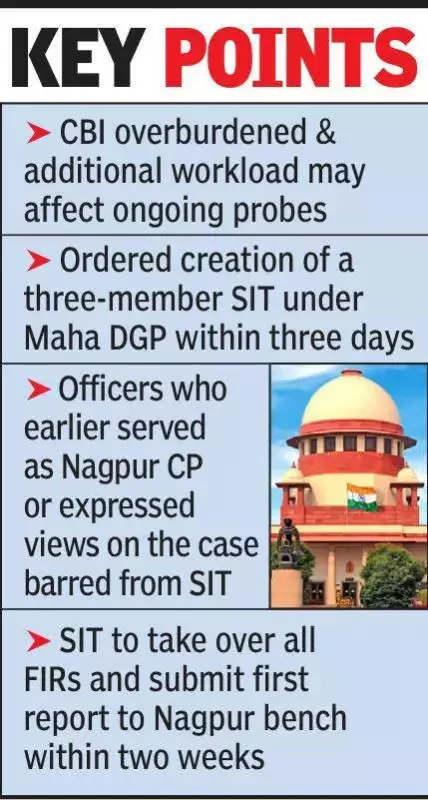
The Supreme Court acknowledged the High Court's concerns but expressed reservations about burdening the CBI. The bench took "judicial notice of the fact that the hands of the CBI are full." It noted that the agency's engagement in matters of national importance and its strained workload could mean that adding this case might "unintentionally prejudice or adversely impact ongoing prosecutions."

The court concluded that a dedicated SIT, operating under the supervision of the High Court, would ensure both independence and a faster, more focused investigation into the allegations.
Composition and Mandate of the New SIT
Modifying the High Court's order, the CJI-led bench issued specific instructions for the SIT's formation. The Maharashtra Director General of Police (DGP) has been directed to constitute the three-member team within three days. The team must include:
- An officer not below the rank of Commissioner of Police.
- An IPS officer of Superintendent rank.
- A Deputy Superintendent specializing in economic offences.
To ensure impartiality, the Supreme Court mandated a crucial condition: the two seniormost members must be IPS officers "whose roots shall not be traceable to the state of Maharashtra." This means neither officer should originally belong to the Maharashtra cadre. Furthermore, any officers who have previously served as Police Commissioners of Nagpur and expressed opinions on this case are expressly barred from being part of the SIT.
Scope of Investigation and Next Steps
The SIT has been ordered to take charge of all existing First Information Reports (FIRs) and related materials. This includes a specific communication sent by the Nagpur Police Commissioner to the Central Registrar of Cooperative Societies on June 29, 2023. The team's first status report must be submitted to the Nagpur bench of the Bombay High Court within two weeks.
The Supreme Court also requested the High Court to revive several disposed criminal writ petitions—specifically Nos. 16/2024, 1068/2019, and 811/2025—solely for the purpose of supervising the SIT's work until the investigation reaches its logical conclusion.
The bench was careful to clarify that its order should not be seen as an opinion on the merits of the allegations. "All such factual issues are required to be objectively investigated," the court stated, declining to discuss the accusations further.
Background of the Allegations
The case revolves around serious allegations against the Nirmal Multi-State Credit Co-operative Society. Members and investors have accused the Society's management of misappropriating and diverting member deposits worth crores of rupees across its branches in two states.
The High Court bench, in its earlier order, had highlighted repeated lapses by state authorities. It referenced observations made by a former Commissioner of Police of Nagpur, who had flagged severe violations. These alleged violations included:

- Accepting deposits from non-members.
- Exceeding deposit limits prescribed under Section 67 of the Multi-State Co-operative Societies (MSCS) Act, 2002.
- Showing interest from non-performing assets (NPAs) as profit to attract more investors.
- Diversion of a massive Rs 317.73 crore to other enterprises without obtaining necessary approval from the Central Registrar.
The Supreme Court's order brings a new structure to this complex probe, aiming for a swift and unbiased investigation into these grave financial charges.