

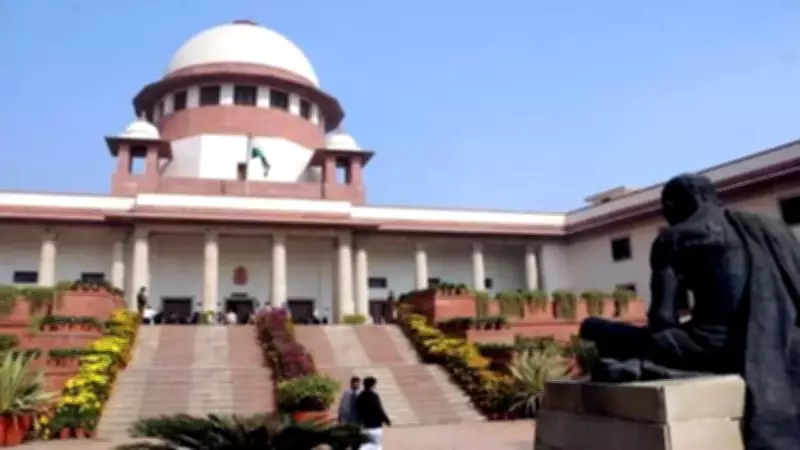
The Supreme Court of India has delivered a landmark judgment on the Immoral Traffic Prevention Act (ITPA), stating that the primary objective of the 70-year-old law is not to abolish prostitution or make it a criminal offence, but to prevent its commercialisation. A bench comprising Justices J B Pardiwala and R Mahadevan conducted an exhaustive and microscopic analysis of the Act and concluded that the legislation aims to inhibit the commercialisation of prostitution, rather than targeting individual sex workers.
Key Observations by the Supreme Court
The bench observed that the ITPA was enacted to punish perpetrators of trafficking and exploitation, not the prostitutes themselves. The court stated, "We are sure that abolition of prostitution or making prostitution a criminal offence is not the principal object of the Act. Rather, what it aims for is the inhibition or abolition of the commercialisation of prostitution, i.e., prostitution as an organised means of living."
Historical Context and Legislative Intent
While addressing the rehabilitation of women rescued from brothels, the bench examined the historical context of the 1956 Act. It noted that at the beginning of the 20th century, trafficking of women for prostitution was widespread and considered immoral, which led to the inclusion of the word 'immoral' in the law. The court emphasised that the primary focus of the ITPA is to combat organised exploitation, not to penalise individuals engaged in sex work for survival.

Exceptions to the General Rule
In its 298-page judgment, Justice Pardiwala clarified that Sections 7 and 8 of the Act are exceptions to this general principle. Section 7 penalises prostitution in close proximity to public places, while Section 8 criminalises soliciting customers in public spaces. The bench explained, "The idea being that although individual acts of prostitution are not sought to be directly shunned, yet public decency and social morality require that visible overtures even for such singular, non-commercial forms of prostitution be deterred in areas surrounding public institutions and other notified regions to prevent public nuisance."
Clarification on the Definition of 'Brothel'
The court also examined the definition of 'brothel' under Section 2 of the Act. It ruled that a single woman practising prostitution for her own livelihood, without the involvement of another prostitute or a third person in maintaining the premises, does not constitute a brothel. The judgment stated, "It must be clarified that where a single woman practises prostitution for her own livelihood, without another prostitute, or some other person being involved in the maintenance of such premises, her residence will not amount to a 'brothel'."
Conclusion
The Supreme Court made it clear that it was not advocating for either absolute criminalisation or complete deregulation of prostitution as a trade. Instead, it highlighted the normative ambiguity in the current definition, which often portrays sex work solely as abusive or exploitative. The judgment underscores the need for a nuanced approach that distinguishes between consensual individual acts and organised commercial exploitation.






