

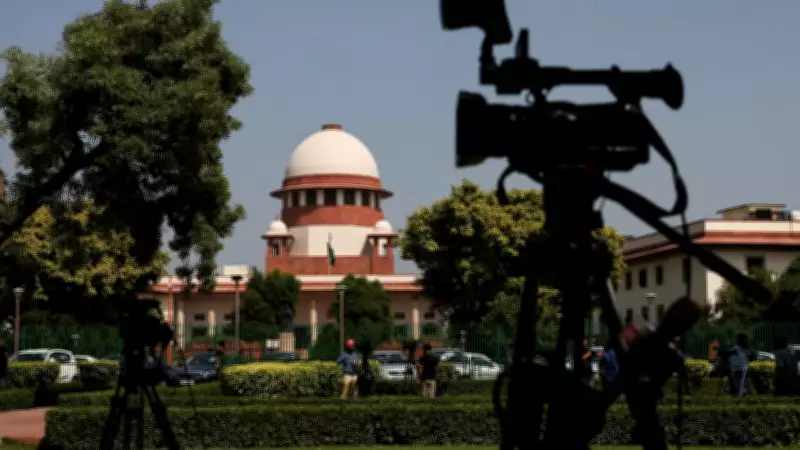
Supreme Court Issues Stern Rebuke to West Bengal Government Over ED Plea Objections
The Supreme Court of India delivered a sharp reprimand to the West Bengal government on Wednesday for its objections to the validity of an Enforcement Directorate (ED) plea. The central agency's petition alleges obstruction by Chief Minister Mamata Banerjee during a raid on I-PAC, a political consultancy firm.
Constitutional Vacuum Cannot Be Tolerated, Says Bench
A bench comprising Justices Prashant Kumar Mishra and NV Anjaria firmly observed that no entity can be left without a remedy under the Constitution of India. The court posed a critical question: how would the central probing agency seek legal recourse if it is barred from approaching the courts?
"If the ED, according to you, cannot file a writ petition under Article 32, then surely it cannot approach the high court under Article 226 either. Where will they go? There cannot be a vacuum," the top court stated emphatically.

Allegations of Obstruction Raise Larger Constitutional Concerns
The bench also pulled up Chief Minister Mamata Banerjee over the serious allegation of obstructing ED officials during the raid. The court underscored that this issue raises larger constitutional concerns about the rule of law and the independence of investigative agencies.
Senior advocate Shyam Divan, appearing for the state of West Bengal, argued that the ED is not a juristic entity and therefore lacks the standing to file writ petitions. He contended that only the Union of India possesses the authority to initiate such proceedings, warning that allowing individual departments to independently invoke writ jurisdiction could disrupt India's federal structure.
Legal Arguments and Counterarguments Intensify
Senior advocate Kapil Sibal, representing Mamata Banerjee, supported this position by arguing that the ED cannot seek directions for a Central Bureau of Investigation (CBI) probe into the alleged obstruction. This legal battle comes as the Enforcement Directorate, in its original plea, has sought:
- Registration of a First Information Report (FIR) against Mamata Banerjee and involved police officials
- Challenging an FIR filed by West Bengal Police against its own officers
Background and Previous Court Directives
Earlier, on January 15, the Supreme Court had termed the alleged obstruction "very serious" and took decisive action by staying all FIRs against ED officials who conducted the controversial raid. The court also directed West Bengal Police to preserve all CCTV footage from the operation for evidentiary purposes.
The court had previously issued formal notices to multiple parties including Mamata Banerjee, the West Bengal government, former Director General of Police Rajeev Kumar, and other senior police officials. These notices were in response to the ED's plea seeking a CBI investigation into the alleged obstruction during the raid.
This ongoing legal confrontation highlights significant tensions between state and central authorities, with constitutional principles of federalism, separation of powers, and access to judicial remedies at the forefront of the debate. The Supreme Court's intervention underscores the judiciary's role in maintaining institutional balance and ensuring that all entities, including investigative agencies, have appropriate legal pathways to address grievances.






