Supreme Court Criticizes Bombay High Court's 'Fundamental Flaw' in Teacher Dismissal Case
The Supreme Court of India has recently set aside an order from the Nagpur bench of the Bombay High Court in a contentious teacher dismissal dispute. The apex court strongly held that the High Court committed a "fundamental flaw" by limiting its decision to a single decisive point without thoroughly examining all questions raised by the involved parties.
Background of the Nagpur Teacher Dismissal Case
The case centers on a Nagpur-based teacher who was dismissed from service by the Shubham Bahu-Uddeshiya Sanstha in Waddhamna in May 2017 due to alleged misconduct. In August 2019, the School Tribunal in Nagpur intervened, setting aside the dismissal order and directing her reinstatement with all consequential benefits.
However, in September 2024, the Nagpur bench of the Bombay High Court allowed a petition filed by the educational institution. The High Court remanded the matter back to the tribunal for reconsideration, noting that the tribunal had failed to examine certain critical records. Specifically, the High Court pointed to a resolution that authorized the institution's secretary to initiate disciplinary proceedings against the teacher.

Allegations of Natural Justice Violations
The teacher subsequently sought a review in the High Court, arguing that the disciplinary inquiry was conducted in violation of the principles of natural justice. Her plea contended that she was not permitted to complete the cross-examination of the management's key witness and other witnesses.
According to her detailed submission, the cross-examination of the main witness was actively in progress on July 31, 2017. Shockingly, the inquiry officer abruptly closed the proceedings on August 1, 2017, without allowing its completion. The High Court rejected this review petition in September 2024.
Supreme Court's Landmark Ruling and Directives
A bench comprising Justices Dipankar Datta and Satish Chandra Sharma delivered a significant verdict, emphasizing that courts are required to provide reasoned findings on all issues. The Supreme Court held that the High Court "appears to have faltered" by deciding the matter solely on the question of whether the institution's secretary had the authority to initiate disciplinary proceedings.
In a decisive move, the Supreme Court set aside both the High Court's order allowing the institution's plea and the order rejecting the teacher's review petition. The case has been remanded to the Bombay High Court for fresh consideration, with instructions to examine all claims and defenses presented by the parties comprehensively.
Key Implications and Future Proceedings
The judges also noted a critical development: the teacher has already attained the age of superannuation, making reinstatement in service highly unlikely. Consequently, the High Court will now need to determine several pivotal issues:
- Whether the School Tribunal was justified in interfering with the disciplinary action initially.
- Whether the teacher is entitled to back wages and retiral benefits despite the dismissal.
The Supreme Court has requested the Chief Justice of the Bombay High Court to assign the petition to an appropriate bench and dispose of it preferably within four months. Additionally, the apex court left open the possibility for the parties to explore a mediated settlement, potentially offering a quicker resolution.

Essential Takeaways from the Supreme Court Ruling
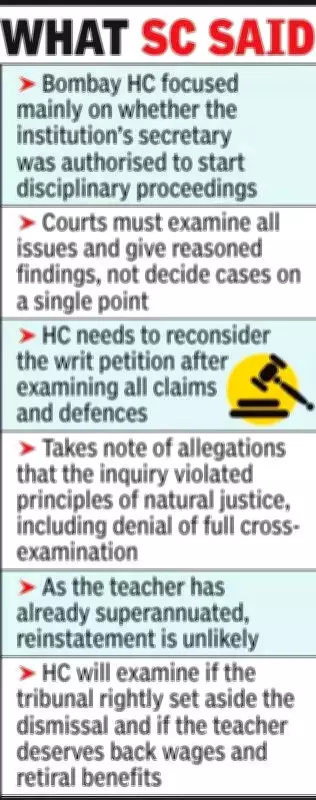
- The High Court decided the matter by focusing mainly on whether the institution's secretary was authorized to initiate disciplinary proceedings, which the Supreme Court deemed insufficient.
- Courts must address all issues in dispute and provide reasoned findings instead of deciding cases on a single decisive point.
- The High Court is directed to reconsider the writ petition afresh after examining all claims and defenses of the parties thoroughly.
- The Supreme Court noted serious allegations that the disciplinary inquiry violated principles of natural justice, including the denial of full cross-examination rights.
- Since the teacher has already reached superannuation, reinstatement is now unlikely, shifting focus to financial compensations.
- The High Court will examine whether the tribunal rightly set aside the dismissal and whether the teacher is entitled to back wages and retiral benefits.
- The Chief Justice of Bombay High Court is requested to assign the case to a roster bench and dispose of it preferably within 4 months.
- The option for the parties to explore a mediated settlement remains open, as suggested by the Supreme Court.
This ruling underscores the judiciary's commitment to ensuring that all legal disputes are adjudicated with comprehensive analysis and fairness, particularly in employment matters involving fundamental rights and natural justice principles.