

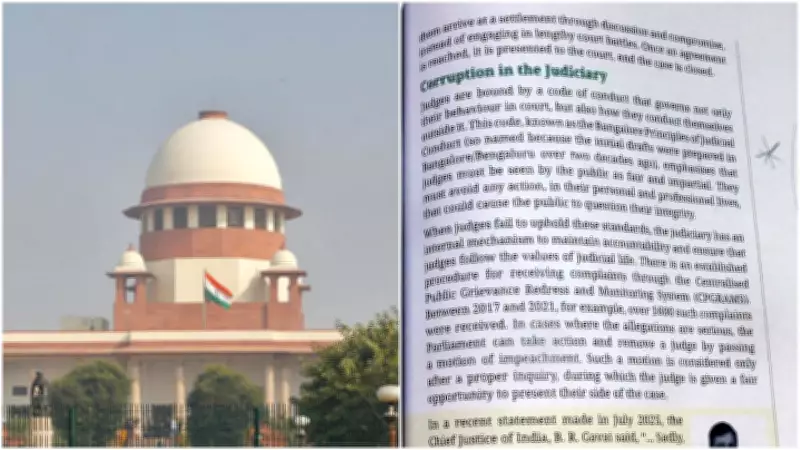
Supreme Court Takes Suo Motu Cognizance of NCERT Textbook on 'Corruption in Judiciary'
The Supreme Court of India has taken suo motu cognizance of a controversial NCERT textbook that includes content on 'corruption in the judiciary'. This move by the apex court highlights its proactive stance in addressing what it perceives as an attack on its integrity and reputation.
Bench Led by Chief Justice of India Issues Strong Remarks
A bench led by the Chief Justice of India, in its proceedings, stated that the inclusion of such material in the NCERT textbook appears to be a "deliberate" and a "calculated measure" aimed at defaming the institution. The court emphasized that this action could undermine public trust in the judiciary, which is a cornerstone of democracy.
The suo motu cognizance means the court has taken up the matter on its own initiative, without any formal petition or complaint being filed. This underscores the seriousness with which the Supreme Court views the issue, considering it a potential threat to judicial independence and credibility.

Context and Implications of the NCERT Textbook Content
The NCERT textbook in question, part of the educational curriculum, discusses topics related to corruption within the judiciary. While the exact details of the content have not been fully disclosed, the Supreme Court's response indicates that it contains assertions or implications that are seen as damaging to the judicial system.
This development raises important questions about the balance between academic freedom and the protection of institutional reputation. On one hand, educational materials should encourage critical thinking and transparency. On the other hand, the judiciary must safeguard its authority and public confidence, which are essential for the rule of law.
The Supreme Court's intervention is likely to prompt a review of how such sensitive topics are presented in school textbooks. It may lead to discussions among educators, policymakers, and legal experts about appropriate ways to address issues of corruption without compromising respect for judicial institutions.
Potential Outcomes and Broader Impact
As the Supreme Court continues to examine this matter, several outcomes are possible:
- Revision of Textbook Content: The court might direct NCERT to modify or remove the contentious sections to prevent further controversy.
- Guidelines for Educational Materials: This case could result in the establishment of new guidelines for discussing judicial and governmental institutions in academic texts.
- Legal Precedent: The suo motu action sets a precedent for how courts can respond to perceived defamation through educational channels, potentially influencing future cases.
The incident also highlights the ongoing tensions between freedom of expression and institutional dignity in India. It serves as a reminder of the delicate role that educational resources play in shaping public perception and the need for careful consideration in their development.
In conclusion, the Supreme Court's suo motu cognizance of the NCERT textbook on 'corruption in the judiciary' marks a significant moment in the intersection of education and law. By labeling it a deliberate and calculated move to defame the institution, the court has taken a firm stand to protect its integrity, sparking a broader debate on accountability and respect in democratic discourse.






