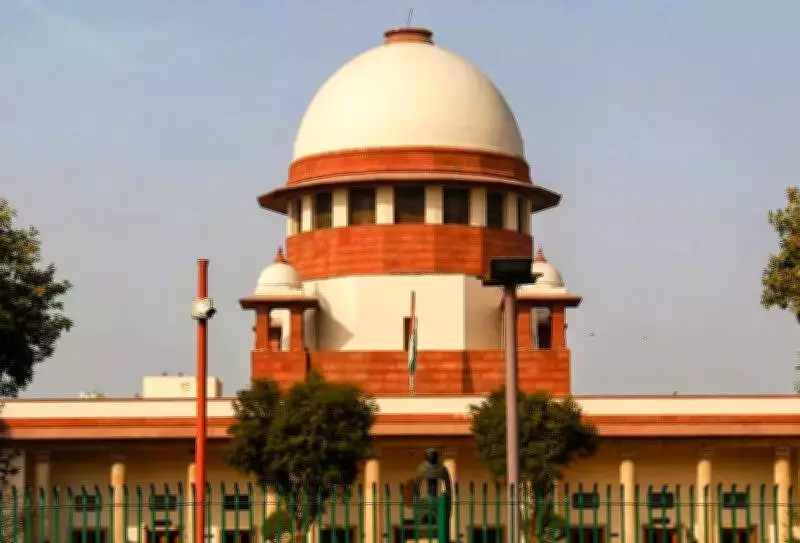
Supreme Court Takes Up Mumbai's Green Space Protection Case
In a significant development, the Supreme Court of India has agreed to examine crucial measures to safeguard Mumbai's parks, gardens, and maidans from encroachments. This decision comes in response to a petition filed by the NGO Alliance for Governance and Renewal (NAGAR), which has raised serious concerns about the systematic gobbling up of these vital open spaces.
The Core Issue: Policy Misuse and Encroachment Patterns
The NGO has presented compelling arguments that land mafia and builders are actively encouraging encroachments on these green lungs of Mumbai. Their strategy allegedly involves exploiting the policy framework designed for in-situ rehabilitation of slum dwellers. According to the petitioner, this misuse is leading to the gradual disappearance of public open spaces that are essential for the city's environmental health and citizen well-being.
A bench comprising Chief Justice Surya Kant and Justice Joymalya Bagchi acknowledged the complexity of the situation. While noting that protecting non-encroached parks and gardens would be straightforward, the justices recognized the delicate balance required when dealing with slum dwellers who have occupied these areas for extended periods.
Judicial Observations and Government Response
The CJI-led bench made insightful observations during the hearing, stating: "Slum dwellers must have basic amenities in their houses. At the same time, if one person encroaches on an open area and it gets reserved for in-situ rehabilitation of slum dwellers, then it is a problem of different magnitude." This statement highlights the court's awareness of both humanitarian concerns and the larger public interest at stake.
The Supreme Court has formally sought responses from the Maharashtra government and the Brihanmumbai Municipal Corporation (BMC), indicating the seriousness with which it views these allegations. This move suggests the court intends to thoroughly examine the regulatory framework and its implementation.
Legal Arguments and Policy Evolution
Senior advocate Shyam Divan, representing NAGAR, presented detailed arguments before the bench. He clarified that the petitioner has no objection to in-situ rehabilitation of slum dwellers per se, but strongly opposes conducting such rehabilitation on encroached open spaces. "They can be rehabilitated around the same area, sparing the open areas for common use of citizens," Divan emphasized, proposing a balanced approach.
The legal team highlighted significant changes in development regulations over time. The Development and Control Regulations (DCR) of 1991 specified that if 25% or more of an open space was encroached upon by slum dwellers, that site could be used for in-situ rehabilitation with proper housing construction. However, DCR 2034, issued by the Maharashtra government in 2018, introduced a concerning modification.
According to Divan, the newer regulation states that no minimum percentage of a plot area of 500 square meters is required for in-situ rehabilitation of encroachers. He argued that this provision essentially creates an open invitation for land mafia and builders to encourage encroachments, as even a single hut erected on such open space could trigger reservation for rehabilitation projects.
The Broader Implications and Historical Context
The petitioner's appeal raises fundamental questions about urban planning and public resource allocation. It argues that "perpetuating the illegality of encroachment by sanctioning construction leads to irreversible consequences." Once open spaces are lost to construction, they cannot be regained, creating permanent deprivation for the larger public.
Adding historical perspective to the case, the appeal before the Supreme Court was drafted by senior advocate Madhvi Divan, who had drafted the first petition on this issue twenty-four years ago for the Bombay High Court. Both Madhvi Divan and Shyam Divan presented the case before the CJI-led bench, bringing decades of legal expertise to this ongoing urban conservation battle.
This case represents more than just a legal dispute; it touches upon Mumbai's urban future, environmental sustainability, and equitable resource distribution. As the Supreme Court examines these complex issues, its eventual decision could have far-reaching implications for how Indian cities balance development needs with environmental preservation and public space protection.