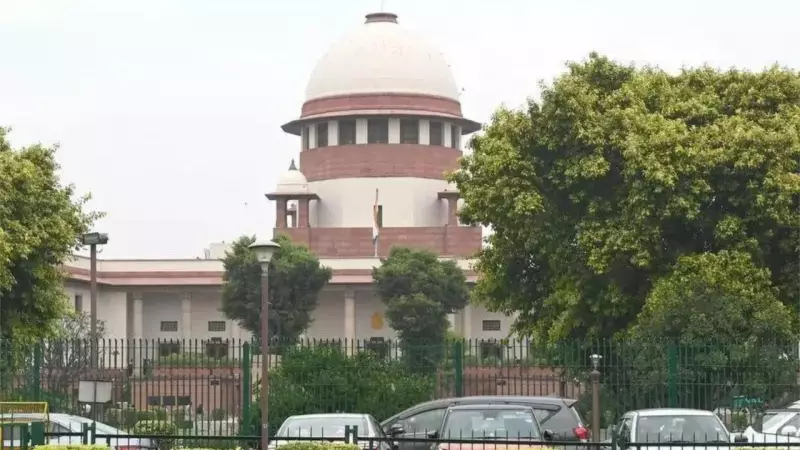
The Supreme Court of India has stepped in on its own motion to address the growing controversy surrounding its recent order defining the Aravali hills. The court has registered a suo motu case, which is scheduled for hearing on Monday, following significant opposition from environmentalists and citizens.
Bench to Examine Definition and Ancillary Issues
The case, listed on the Supreme Court website as a suo motu civil matter regarding the 'Definition of Aravali Hills and Ranges and Ancillary Issue', will be taken up by a bench comprising Chief Justice Surya Kant and Justices J K Maheshwari and A G Masih. This move comes after the court's November 20 order, which accepted an expert committee's definition, continued to spark debate.
In its November ruling, the apex court accepted the committee's definition for the context of mining. It defined an Aravali Hill as any landform in the Aravali districts with an elevation of 100 meters or more, measured from the local relief. An Aravali Range was defined as two or more such hills located within 500 meters of each other.

Environmental Concerns and Legal Arguments
The expert committee that provided this definition included the secretary of the Ministry of Environment, Forest and Climate Change (MoEFCC), forest secretaries from Delhi, Haryana, Rajasthan, and Gujarat, and representatives from the Forest Survey of India (FSI), Central Empowered Committee, and Geological Survey of India.
However, this definition has been sharply criticized. Environmentalists argue that it could lead to massive mining activities on hills below the 100-meter threshold, thereby destroying the ecological continuity and integrity of the Aravalis.
During earlier hearings, senior advocate K Parameshwar, who was assisting the court as amicus curiae, strongly objected. He contended that accepting the committee's definition would "totally endanger the environment and ecology of the mountains." He warned that all hills below 100 meters would be opened for mining, fragmenting the range.
Government's Stance and the Road Ahead
Opposing this view, Additional Solicitor General Aishwarya Bhati argued for the government. She submitted that if the definition suggested by the Forest Survey of India—based on a slope of 3 degrees or more—was accepted, it would exclude large areas. She maintained that the committee's definition would, in fact, include a larger area under the protective umbrella of the Aravali Hills and Ranges.
With the Supreme Court now taking suo motu cognisance, the legal and environmental debate is set for a fresh judicial examination. The hearing on Monday is expected to delve into these competing arguments, balancing environmental protection with regulatory definitions. The outcome will have significant implications for the future of the ecologically fragile Aravali range.