

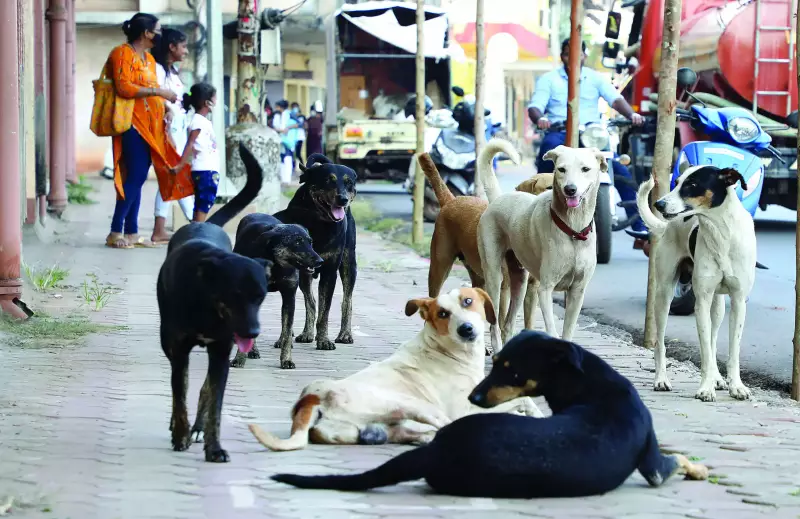
The Supreme Court of India made a striking remark on Thursday, stating it would play a video at the next hearing to test a petitioner's "sense of humanity." This came during a hearing on allegations of "inhuman" treatment of stray dogs by the Municipal Corporation of Delhi (MCD).
A Heated Exchange in Court
Senior advocate Kapil Sibal, representing the petitioner, informed a bench comprising Justices Vikram Nath and Sandeep Mehta that a special three-judge bench scheduled for the day had been cancelled. When Justice Nath proposed taking up the case in January, Sibal urgently requested a hearing for Friday, citing immediate concerns.
"The problem is that, in the meantime, the MCD has framed certain rules that are completely contrary. What is being done is very, very inhuman," argued Sibal.

In a pointed response, Justice Sandeep Mehta remarked, "On the next date, we will play a video for your benefit and ask you what is humanity." Sibal countered, stating the petitioner would also present a video to show the ground reality and highlighted that the MCD planned to implement its new rules as early as December.
The Core of the Conflict: Shelters and Rules
Kapil Sibal elaborated on the practical dilemma, expressing respect for the court's earlier orders but pointing to a statutory conflict. "The difficulty is that your lordships have passed an order, which we fully respect. However, there are statutory rules, and the MCD will implement them. They will remove the dogs, but they do not have shelters," he noted.
The bench, after considering the arguments, scheduled the next hearing for January 7.
Background of the Supreme Court's Suo Motu Case
This legal battle originates from a suo motu case initiated by the Supreme Court on July 28. The court acted on a media report detailing incidents of stray dog bites leading to rabies, particularly among children, in the national capital.
On August 11, the court directed that all stray dogs in the Delhi-NCR region be removed to shelters in response to the rising number of bite and rabies cases. However, following public protests, the court modified its order just 11 days later, on August 22.
The modified order clarified that dogs would be released back into their original areas after sterilisation and immunisation. It explicitly stated that dogs infected with rabies or displaying aggressive behaviour would not be released and would instead be housed in shelters.
The court intervened again on November 7, taking note of an "alarming rise" in dog bite incidents within institutional areas like schools, hospitals, and railway stations. It directed the immediate relocation of stray dogs to designated shelters after due sterilisation and vaccination.
The upcoming hearing in January is now poised to be a critical juncture, with both sides preparing video evidence to support their claims on what constitutes humane treatment in Delhi's ongoing struggle to manage its stray dog population and public safety concerns.






