

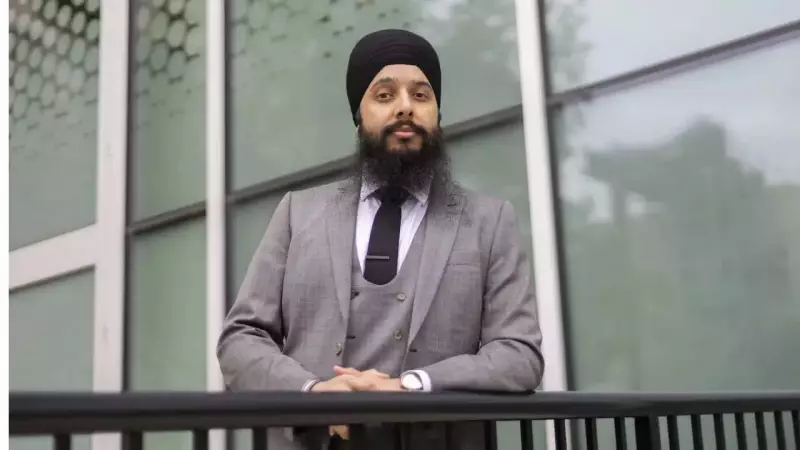
A Sikh lawyer's principled stand against a mandatory professional oath has resulted in a landmark legal victory in Canada, reinforcing the primacy of religious freedom. Prabjot Singh Wirring, preparing to enter the legal profession in Alberta, found himself at the heart of a constitutional clash when a provincial requirement demanded he swear allegiance to King Charles III.
The Constitutional and Religious Conflict
For Wirring, an initiated Amritdhari Sikh, the mandatory oath presented an irreconcilable conflict with his core religious beliefs. Alberta, at the time, required all new lawyers to swear this oath as a non-negotiable condition for admission to the provincial bar. While other Canadian provinces often provide alternatives or make such oaths optional, Alberta's rule was strict.
Wirring's faith dictates that he can swear allegiance only to Akal Purakh, the timeless divine being in Sikhism. To pledge "true allegiance" to a temporal monarch would violate a prior and absolute religious commitment. Faced with an impossible choice between his career and his conscience, Wirring chose to challenge the rule in court in 2022.

A Legal Battle Through the Courts
The journey was not immediate. A lower court initially dismissed Wirring's case in 2023, dismissing the oath as a largely symbolic formality that did not meaningfully infringe on religious freedom. Undeterred, Wirring appealed the decision, bringing the matter before the Alberta Court of Appeal.
On December 16, 2025, a unanimous three-judge panel of the Alberta Court of Appeal delivered a historic verdict. They overturned the lower court's ruling, finding decisively that the oath was not merely symbolic. The court recognized that it placed a "real and substantial burden" on Wirring by making his professional future contingent on an act that violated his faith.
The Landmark Ruling and Its Implications
The Court of Appeal ruled that the mandatory oath violated Section 2(a) of the Canadian Charter of Rights and Freedoms, which guarantees freedom of conscience and religion. The court declared the requirement to be of no force or effect and ordered the Alberta provincial government to rectify the issue within 60 days.
The judges outlined several potential remedies for the province, including:
- Abolishing the oath for lawyers entirely.
- Making the oath optional rather than compulsory.
- Amending the oath's wording to remove the compulsory allegiance to the monarch.
The ruling has ignited a broad debate across Canada. Civil liberties groups have hailed it as a vital affirmation that professional gatekeeping cannot override fundamental Charter rights. They argue it aligns Alberta with more flexible practices in other provinces and reflects Canada's modern, pluralistic identity.
Conversely, some critics view the decision as an erosion of Canada's constitutional traditions as a constitutional monarchy. They contend that within the Westminster system, where legal authority derives from the Crown, the oath represents a meaningful civic commitment.
For Prabjot Singh Wirring, the verdict is a personal and professional vindication. A Dalhousie University law graduate based in Edmonton, his steadfastness has not only secured his own path to practicing law but has also established a crucial precedent protecting the religious freedoms of all professionals in Alberta.






