Dr. Abhishek Manu Singhvi Urges Overhaul to Combat Judicial Pendency Crisis
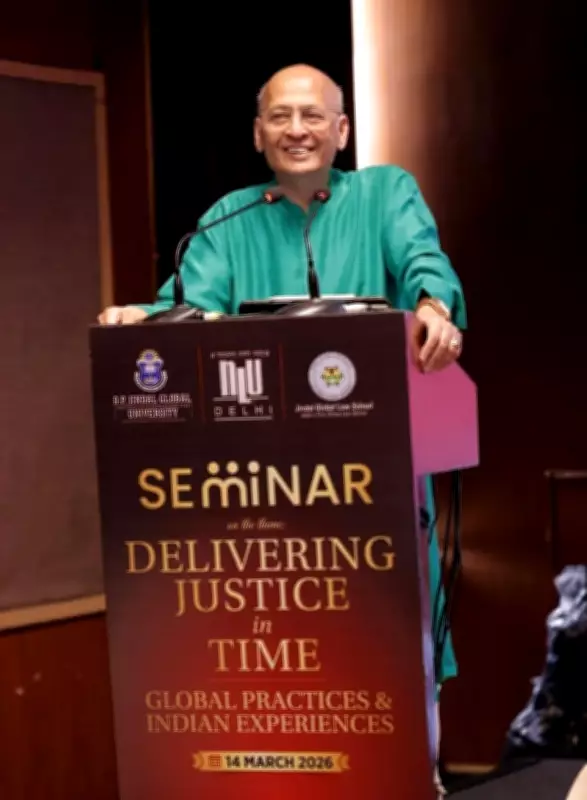
In a compelling keynote address at a seminar titled "Delivering Justice in Time: Global Practices and Indian Experiences," Dr. Abhishek M. Singhvi, Senior Advocate at the Supreme Court of India and Member of Parliament, called for radical reforms to address the severe backlog of cases plaguing the Indian judiciary. The event was jointly organized by O.P. Jindal Global University and the National Law University Delhi in New Delhi on March 17, 2026.
Paradox of Excellence and Pendency
Dr. Singhvi described the situation as a paradox, noting that India boasts advanced jurisprudential doctrines and legal brilliance, yet faces a staggering backlog. "Today we have near-abouts 4.7 to 5.5 crore cases in current arrears," he stated, emphasizing the urgency of the issue.
Concentrated Pendency and Vacancy Crisis
He highlighted that 54% of pending cases, based on 2019 data, are concentrated in five High Courts: Uttar Pradesh, Punjab, Madras, Bombay, and Rajasthan. Criminal matters constitute the bulk of these delays. Dr. Singhvi pointed out a critical vacancy problem: "At any point of time in our roughly 80-year-old history, one third of all High Court sanctioned posts and one fourth of the total district or lower judiciary posts remain vacant!" He advocated for a consistent policy over 5-7 years to tackle what he termed the ABCD issues: Access, Backlog, Cost, and Delay.
Innovative Solutions Proposed
Dr. Singhvi proposed several bold measures:
- Statistical Analysis and Multiple Tracks: Apply management techniques to courts, using statistical profiles on time dependency and case categories. Implement separate tracks for new filings (within 3-5 months) and old cases (over 5-10 years).
- Ad-hoc Judges: Utilize constitutional provisions to appoint ad-hoc judges in High Courts, leveraging experienced retired judges to fill vacancies, as this amendment has rarely been used.
- Mediation Expansion: Build on the success of Lok Adalats, which settled over 20 crore cases in 2023, by expanding their scope to include petty civil and criminal offenses to prevent system clogging.
- Reforming Arbitration: Address the failure of arbitration, which has become "pre-litigation litigation," by promoting mediation and conciliation instead.
- Criminal Justice Reforms: Experiment with ankle monitoring systems for certain crimes to reduce undertrial populations, given India's high prison numbers. Strengthen human infrastructure, as studies show one in four justice system workers is missing.
Support from Academic Leaders
Prof. (Dr.) C. Raj Kumar, Founding Vice Chancellor of O.P. Jindal Global University, praised Dr. Singhvi's insights, stating that his ideas provide a strong foundation for addressing judicial delays while maintaining fairness and public confidence in the rule of law.
The seminar underscored the need for institutional leadership, data-driven governance, and technological innovation to achieve meaningful judicial reform in India.