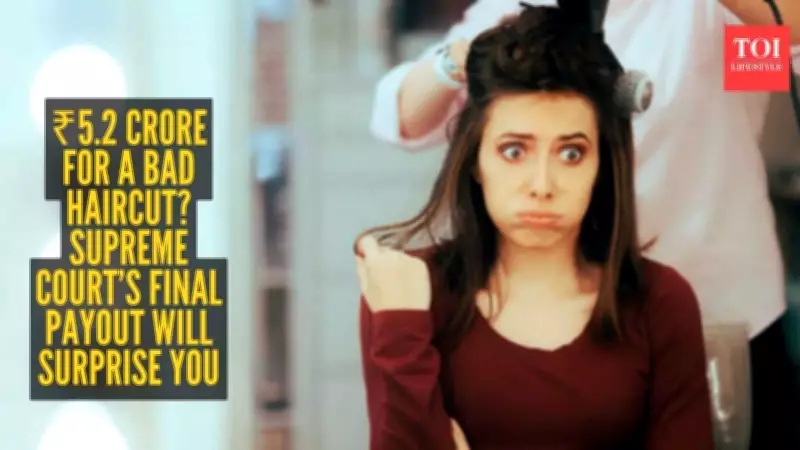
Supreme Court Awards ₹25 Lakh in Landmark Bad Haircut Case, Far Below ₹5.2 Crore Claim
Many individuals visit a salon with straightforward expectations: a quick trim and a modest confidence boost ahead of a significant event. This was precisely the intention of one woman, but her experience spiraled into an unexpected legal battle spanning years. The culmination of this dispute arrived on February 6, 2026, when the Supreme Court of India delivered its verdict, awarding her ₹25 lakh in compensation—a substantial sum, yet a dramatic reduction from the ₹5.2 crore she had demanded.
The Core of the Legal Dispute
The woman initiated legal proceedings, alleging that a salon had severely damaged her haircut, which in turn shattered her confidence and hindered professional modeling opportunities. She contended that the incident caused profound distress, leading to depression and tangible career setbacks. In her view, the harm extended far beyond a mere cosmetic mishap, justifying the massive compensation claim of ₹5.2 crore.
However, the Supreme Court adopted a more cautious and measured perspective. The judges emphasized that compensation calculations cannot rely solely on personal assertions or speculative assumptions. For such an exorbitant amount to be justified, robust evidence demonstrating concrete financial or professional losses is imperative. The court concluded that the proof presented was insufficient to support the ₹5.2 crore demand, though it acknowledged the complainant's genuine distress.
Origins of the Controversial Haircut
The saga traces back to April 12, 2018, when the woman, preparing for a crucial interview scheduled about a week later, visited a salon situated within a five-star hotel in New Delhi. Her goal was simple: achieve a polished hairstyle to enhance her confidence for the interview. She specifically requested a trusted hairstylist, identified in court records as Smt A, due to prior satisfactory experiences.
Unfortunately, Smt A was unavailable that day, and another hairdresser, referred to as Smt C, was assigned to the appointment. The woman expressed reservations, citing past dissatisfaction with Smt C's work, but the salon manager intervened, assuring her of the stylist's improved skills. Reluctantly, she agreed to proceed.
Miscommunication and the "London Haircut" Incident
Before the haircut commenced, the woman provided clear instructions: she desired long flicks or layers in the front to frame her face, and only about four inches trimmed from the back to maintain length. However, complications arose during the process. Wearing high-powered spectacles, she struggled to see the mirror clearly, exacerbated by the stylist instructing her to keep her head tilted downward.
As the haircut extended beyond an hour, she grew concerned and inquired about the delay. The stylist's response—that she was receiving a "London haircut"—only added to her confusion and anxiety. This moment became a pivotal element in the subsequent consumer complaint, which first reached the National Consumer Disputes Redressal Commission before escalating to the Supreme Court.
Broader Implications for Consumer Rights
This case evolved from a routine salon visit into one of India's more unusual consumer disputes, prompting the judiciary to grapple with a complex question: how does one quantify the damage when something as personal as a haircut goes awry? The Supreme Court's ruling underscores the necessity for tangible evidence in compensation claims, balancing consumer protection with legal scrutiny.
The verdict highlights that while emotional and psychological distress are valid considerations, they must be substantiated with proof of actual loss to warrant significant monetary awards. This decision sets a precedent for future consumer cases involving subjective damages, reinforcing the importance of documentation and evidence in legal proceedings.