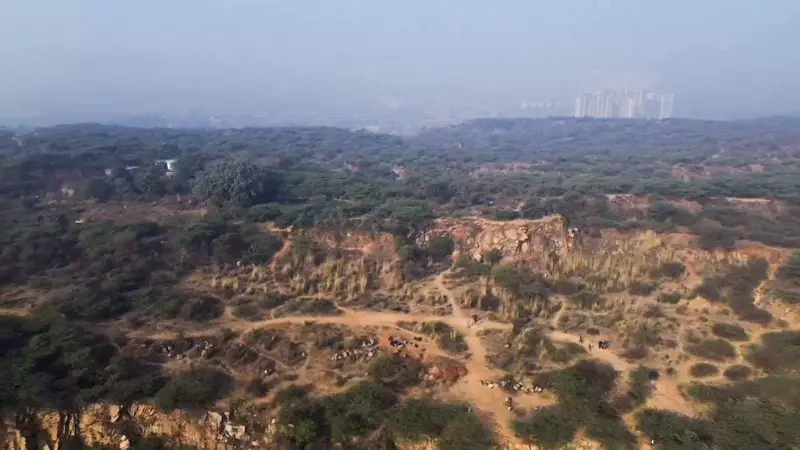
In a significant move, the Supreme Court of India has put its own recent judgment on hold, acknowledging potential flaws in how it defined the ecologically critical Aravalli mountain range. On December 29, 2025, a bench led by the Chief Justice of India ordered the suspension of its November 2025 judgment that provided a legal definition for the Aravalli hills. The Court stated that further clarification was needed before its directions could be implemented, admitting that its earlier approach may have created a "structural paradox" between legal taxonomy and genuine ecological protection.
The Core of the Controversy: A Problem of Definition
The dispute stems from long-standing inconsistencies in defining the Aravallis across the states of Delhi, Haryana, Rajasthan, and Gujarat. The Court's November 2025 definition characterized "Aravalli Hills" as landforms with a minimum elevation of 100 metres from the local relief. It further stated that "Aravalli Ranges" would be formed by two or more such hills within 500 metres of each other.
While this provided administrative clarity, it led to a "problem of negative definition." By specifying what is protected, it automatically excluded everything else. The numerical impact is stark: a Forest Survey of India (FSI) mapping identified 12,081 potential geological formations, but only 1,048 (about 8.7%) meet the 100-metre threshold. This binary classification overlooks complex ecological realities.
Critically, this elevation-based definition mirrors criteria Rajasthan has used since 2006. A 2018 Central Empowered Committee report revealed that during this period, 31 of 128 Aravalli hills in Rajasthan vanished due to illegal quarrying. This history questions whether a uniform but flawed standard truly advances environmental protection.
Ecological Reality vs. Administrative Convenience
The Court's reversal hints at a deeper issue: the preference for administratively convenient, verifiable boundaries over functional ecosystem protection. The FSI had previously proposed an alternative framework based on slope gradients (above 3 degrees) with 100-metre buffer zones, which was endorsed by the Supreme Court's own technical committee in 2010. This approach was rejected in the November judgment.
The Aravallis function as an interconnected system—a barrier against desertification, a zone for groundwater recharge, and a corridor for biodiversity. These roles cannot be captured by elevation measurements alone. The 500-metre gap rule between hills poses another dilemma. If such gaps are excluded from the definition, they could be opened for regulated mining, potentially severing the ecological connectivity of the entire range.
A Shift in Judicial Principle and the Path Forward
This stay order represents a sophisticated form of judicial restraint. The Court is revisiting its stance not due to procedural error, but due to potential substantive inadequacy. It signals concern that the earlier judgment may have placed the "certainty principle" above the precautionary principle—a cornerstone of Indian environmental law established in the Vellore Citizens Welfare Forum case (1996). The precautionary principle mandates preventive action even in the face of scientific uncertainty to avoid serious environmental harm.
The proposed expert committee now faces critical questions:
- Should excluded areas have a graduated protection regime instead of complete deregulation?
- Do elevation-based criteria truly reflect the geological and ecological features needing protection?
- Would a functional approach, focused on ecosystem services and connectivity, be better than rigid morphological criteria?
This episode underscores a fundamental challenge in Indian environmental governance: translating fluid ecological realities into fixed, justiciable legal standards. Courts need clear rules, but ecosystems need adaptive management. The Aravalli case suggests that excessive legal rigidity, while providing certainty, might ultimately undermine the very environmental outcomes it seeks to secure.