Telangana High Court Rebukes HYDRAA for Overstepping Judicial Boundaries
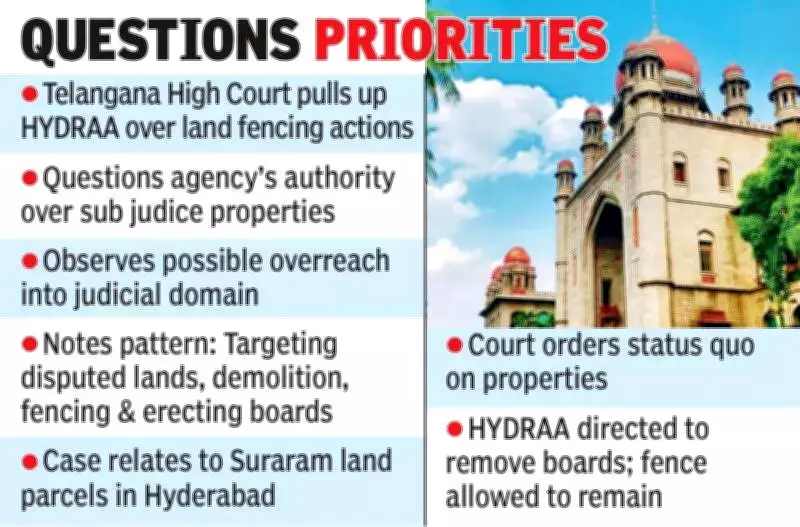
The Telangana High Court has delivered a sharp reprimand to the Hyderabad Disaster Response and Asset Protection Agency (HYDRAA) for its aggressive actions in taking possession of disputed land parcels. Justice NV Shravan Kumar, presiding over the case, questioned whether the agency considers itself "above the courts" or is attempting to run a "parallel government" by unilaterally seizing properties that are currently under judicial review.
Court Questions Agency's Motives and Methods
During the hearing of petitions challenging HYDRAA's actions at Suraram in Hyderabad, Justice Shravan Kumar expressed serious concerns about the agency's pattern of behavior. The judge noted that HYDRAA has been systematically selecting properties that are already embroiled in legal disputes, demolishing existing structures, fencing the land, and erecting boards declaring the properties as government land—all without providing proper notice to the legitimate owners.
"Who authorized you to take possession of such land? Was it the revenue department or the MAUD department?" Justice Shravan Kumar demanded of HYDRAA representatives during the proceedings. The judge emphasized that the agency's actions represent a clear overlap with judicial authority and pointed out that determining property rights and taking possession of disputed lands falls squarely within the court's jurisdiction, not HYDRAA's administrative purview.

Court Orders Immediate Remedial Actions
In response to the petitions, Justice Shravan Kumar issued several important directives:
- Ordered status quo on the disputed land parcels at Suraram
- Directed HYDRAA to immediately remove all boards erected on the properties declaring them as government land
- Allowed existing fences to remain temporarily
- Instructed that the Medchal–Malkajgiri district collector be added as a party to the petitions
- Scheduled the next hearing for June 10 for further proceedings
The judge further mandated that HYDRAA must produce any official permissions or communications that supposedly authorize such aggressive land acquisition actions. Justice Shravan Kumar made it unequivocally clear that unilateral intervention in disputed properties, particularly those already under judicial consideration, cannot be justified under any circumstances.
Questioning Priorities and Potential Conflicts of Interest
Justice Shravan Kumar raised pointed questions about HYDRAA's operational focus, suggesting the agency might have "vested interests" in targeting disputed land parcels. The judge remarked on the apparent discrepancy between HYDRAA's core mandate of protecting water bodies and managing disaster response versus its current preoccupation with land acquisition.
"Why is there no similar urgency in safeguarding lakes and water bodies?" the judge asked, highlighting what appears to be a misalignment of priorities. "If you really want to protect such land parcels, file applications before the court and ask for protection. But how could you go to the land parcels, which are sub judice, and how will you decide the title of the land and take possession of it by throwing all residents out?"
The court's observations suggest a concerning pattern where HYDRAA may be exceeding its statutory authority and potentially interfering with ongoing judicial processes. The agency's actions have raised fundamental questions about the separation of powers between administrative bodies and the judiciary in matters of property disputes.
This case represents a significant judicial check on administrative overreach, with the Telangana High Court asserting its constitutional authority to prevent what it perceives as attempts to bypass established legal procedures for property dispute resolution.