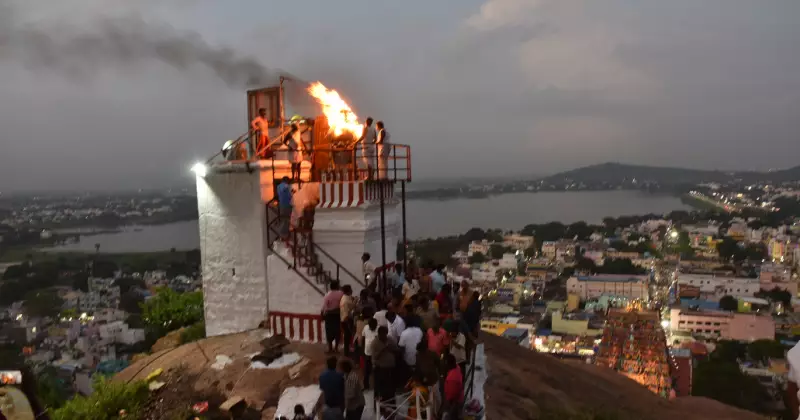
The recent dispute over lighting the Karthigai Deepam on Thiruparankundram hill near Madurai has brought to the fore a complex web of faith, administrative responsibility, and inter-community sensitivities. While the surface issue concerns the exact location for the lamp lighting, the deeper conflict revolves around how state and temple authorities should navigate long-standing traditions, community sentiments, and judicial oversight.
Historical Ownership and Legal Clarity from the Courts
The Madras High Court's judgment on December 1 provides crucial historical and legal context. It meticulously traces major civil suits, including O S No. 4 of 1920 and subsequent appeals, culminating in a final confirmation by the Privy Council. These legal battles conclusively established that the ownership of the hill, barring three small defined areas, is vested in the Subramania Swamy Devasthanam.
The exceptions are specifically the Nellithope, the flight of steps leading to the mosque, and the precise summit area where the mosque stands. Therefore, the deepathoon (lamp pillar), situated on the lower of the two peaks, is unambiguously temple property. The court noted this structure is neither part of the dargah nor geographically close to the mosque, being at a distance of 50 meters or more.

This historical pillar, as per inscriptions documented by Prof. Meyyappan of Annamalai University in a 1984 research publication, dates back to the Naickers' rule. These findings shift the debate from territorial dispute to the realm of temple administration and religious practice.
Temple Administration, Devotee Rights, and State Neutrality
Indian temple jurisprudence recognizes that devotees are stakeholders. Section 6(15) of the Tamil Nadu HR & CE Act acknowledges the rights of "persons having interest." The Supreme Court, in the Bishwanath vs Thakur Radha Ballabhji case, affirmed that a worshipper can intervene when temple authorities fail to act in the institution's interest.
Thus, the demand to light the deepam at the ancient deepathoon is not just symbolic. As the judgment underscores, it is an assertion of the temple's title and its duty to protect its property from encroachment, especially given a history of fragile territorial control.
A 1996 judgment in W P No 18884 of 1994 had allowed the devasthanam to choose a site anywhere on the hill, subject to distance restrictions from the dargah. This framed the lamp's location as an administrative choice, to be made with sensitivity to tradition.
The court criticized the state administration for occasionally adopting a confrontational stance and aligning with one narrative instead of acting as a neutral facilitator. In matters involving multiple religious communities, the state's constitutional role demands principled neutrality to ensure harmony without suppressing legitimate religious expression.
The Imperative for Mediation and a Sustainable Solution
The judgment reveals that past peace committee resolutions had successfully led to consensual outcomes, like allowing deepam lighting beyond 15 meters from the dargah. This proves dialogue can work.
The newly enacted Mediation Act, 2023, which includes provisions for community mediation, offers a perfect framework for this dispute. The Thiruparankundram issue is a prime candidate for such intervention because it involves recurring friction, a long history of misunderstandings, and requires the joint participation of the HR & CE Board, Waqf representatives, local stakeholders, and devotees.
The goal is coexistence, not victory for one side. While the High Court's ruling is firmly grounded in law, the writer suggests that court-annexed community mediation could have been explored, as the dispute is more about future administrative practice than core religious doctrine. A mediated, community-owned consensus would likely foster deeper social legitimacy and lasting peace than a judicial order alone.

Ultimately, the Karthigai Deepam symbolizes illumination. Ensuring its lighting becomes a moment of unity is a shared responsibility of the temple authorities, the state, the communities involved, and the judiciary.