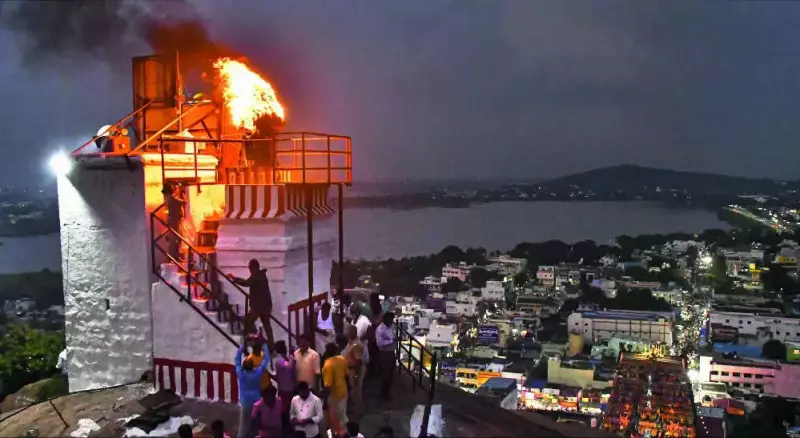
The DMK-led Tamil Nadu government has approached the Supreme Court, seeking an early hearing on its appeal against Madras High Court orders related to the lighting of the traditional 'Karthigai Deepam' at Thiruparankundram hills near Madurai. This move comes even as the state continues to defy the High Court's directives, leading to initiated contempt proceedings.
A Defiant Stand and a Supreme Court Plea
On Friday, a counsel representing the Tamil Nadu government mentioned the appeal before a Supreme Court bench headed by Chief Justice of India Surya Kant and Justice Joymalya Bagchi. The counsel framed it as an issue concerning the "lighting of a lamp on a hilltop" and urged for an urgent hearing. However, CJI Surya Kant offered no immediate assurance, stating only that he would consider listing the case "as soon as possible."
The state has defended its non-compliance with the High Court orders by asserting its exclusive legal rights over the rituals and customs of the Uchi Pillayar temple under the Tamil Nadu Hindu Religious and Charitable Endowment Act, 1959. The High Court had permitted the lighting of the 'deepam' at the stone lamp pillar ('deepathoon') on the hillock, noting it would not encroach upon the rights of the adjacent dargah.

Contempt Proceedings and Allegations of "Drama"
The legal tussle intensified when a single-judge bench of the Madras High Court on Wednesday initiated contempt proceedings against officials. This action followed the state's decision to allow the 'deepam' to be lit at the temple itself, rather than at the designated hilltop location as directed by the court on December 1. A division bench later upheld the single-judge's order and dismissed the state's appeal.
During the Supreme Court mention, advocate P V Yogeswaran, appearing for a caveator, accused the Tamil Nadu government of "creating a drama." He argued that while the state was repeatedly defying the High Court's orders, it was simultaneously filing an appeal in the Supreme Court to potentially dissuade the High Court from moving forward with the contempt proceedings for "blatant, brazen and deliberate defiance."
The Core Legal Conflict
In its Supreme Court appeal, the MK Stalin-led government contends that the High Court cannot use its contempt jurisdiction to question temple rituals and customs, which it claims fall within the exclusive domain of the authorities under the state act. The appeal also highlights a clash between judicial directives and executive authority.
It details that on December 3 at 6:05 PM, the High Court ordered authorities to allow the petitioner to light the lamp on the hilltop. Around the same time, the Madurai District Collector issued prohibitory orders under Section 163 of the BNSS (akin to Section 144 CrPC), banning people from climbing the hillock to prevent a law and order situation.
The division bench, while dismissing the state's appeal, ruled that such executive orders cannot override judicial directions and noted the apparent manipulation in the timing of the prohibitory orders. It termed the state's appeal a "well-designed act" to pre-empt the contempt process. The bench left it to the single judge to decide whether the non-compliance was wilful.
The state's appeal to the Supreme Court raises significant questions about the limits of contempt jurisdiction, the autonomy of temple management, and the interface between judicial orders and executive law-and-order measures. The outcome will set a crucial precedent for similar disputes between religious customs, state control, and judicial oversight.