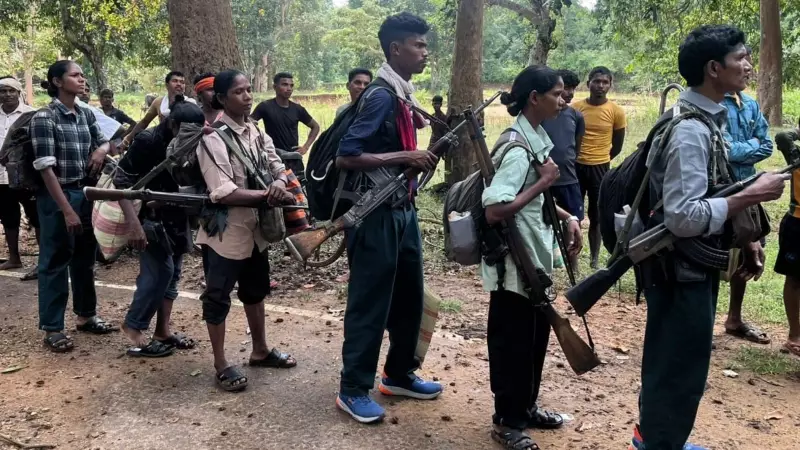
In a dramatic development signaling the potential demise of Left-Wing Extremism in a key region, two top Maoist commanders from the same village met starkly different fates. While the most-wanted leader Madvi Hidma was killed in an encounter, his protege and deputy, Barsa Deva, chose to surrender along with dozens of cadres, leading police to declare the end of the Maoist movement in its former stronghold.
From Same Village to Top Ranks, Then Divergent Paths
Barsa Deva alias Barsa Sukka, a senior commander of the banned People's Liberation Guerrilla Army (PLGA) Battalion 1, formally surrendered before the Telangana Police on Saturday. He was accompanied by at least 48 Maoist cadres in a ceremony that authorities hailed as a decisive blow. This event followed the death of his mentor, Madvi Hidma, in a security forces encounter in Andhra Pradesh in November last year.
Intriguingly, both leaders hailed from Puwarti village in Sukma district, the southernmost part of Chhattisgarh's conflict-ridden Bastar region. Hidma, described as the architect of some of the bloodiest attacks on security personnel, had rejected repeated appeals from the Centre and the Chhattisgarh government to surrender. Deputy Chief Minister Vijay Sharma had even met both families to urge them to lay down arms.

Deva's surrender came nearly two months after Hidma, his wife, and four others were surrounded and killed in the Maredumilli forest of Alluri Sitarama Raju district on November 18, while allegedly trying to flee Chhattisgarh.
The Final Ultimatum and a Choice for Life
According to Telangana Police sources, Deva's decision was precipitated by a narrow escape. Elite anti-Maoist units from several states had cornered him near the Telangana border and presented him with a final option. "He was told that any attempt to flee would be his last moment on Earth," revealed a senior official. "He understood the gravity. He saw what happened to his boss, Hidma, and made the wise choice to surrender."
This choice carries profound symbolic weight. "Deva's decision not to follow his mentor Hidma's 'do or die' diktat is significant because he worshipped Hidma and was his loyal lieutenant," the official explained. "He wisely decided to give up violence and try integrating into mainstream society."
Following Hidma's death, Deva had taken over the leadership of the notorious PLGA Battalion 1. His surrender included a significant cache of weapons, including 48 light machine guns (LMGs), underscoring the battalion's former firepower.
Bloody Past and a Strategic Surrender
Barsa Deva was no minor figure. A member of the Dandakaranya Special Zonal Committee of the CPI (Maoist), he carried a bounty of over Rs 50 lakh. He is accused of involvement in numerous attacks, including the deadly 2013 ambush on Congress leaders in Sukma, and is alleged to have participated in operations that killed over 100 security personnel.
His rise from a volunteer in the Dandakaranya Adivasi Kisan Mazdoor Sangh to a ruthless commander had initially caught Hidma's eye, who took him under his wing. Deva later oversaw Maoist operations across Bastar, Dantewada, and Sukma with an iron fist.
An official noted the strategic nature of his surrender location: "Deva has a lot of blood on his hands, and security forces in several Maoist-affected states are baying for his blood, which explains his choice to surrender in Telangana, where he is not wanted." After surrendering, Deva expressed a desire to visit his native village in Chhattisgarh to meet his family, a request the police said they would facilitate with monitoring.
The Endgame for Maoist Influence in Sukma
The Telangana Police interpret this dual event—Hidma's death and Deva's surrender—as the conclusive end of the Maoist movement in its once-impregnable bastion. A day before the surrender, Telangana Director General of Police B Shivadhar Reddy told The Indian Express that with these developments, "there is no one else to carry forward violent Maoist activities."

He elaborated post-surrender, stating the movement had been "finished" in the area and that even Deva's own villagers would not support any return to insurgency. "We will keep tabs for some time," Reddy assured, but emphasized that the structural leadership necessary to sustain the armed struggle had been irreparably broken.
This surrender marks a pivotal moment in the long-standing conflict in Central India, suggesting a significant erosion of the Maoist command structure in one of its most historically active regions.