In a significant development for security forces in central India, ten Maoists from the Kanha-Bhoramdeo division laid down their arms in Balaghat, Madhya Pradesh. The group included one of the region's most-wanted commanders, Surendar alias Kabir, who carried a bounty of Rs 77 lakh on his head.
The Orchestrated Surrender: Backchannel Talks and a Trusted Intermediary
The surrender, which took place late on Saturday night, December 7, 2025, was not a sudden event but the result of meticulous planning by the Special Intelligence Unit of the Hawk Force. Officials revealed that the process began with multiple rounds of backchannel communications. The initial contact was made through a trusted forest guard operating in the Kanha National Park area, who acted as a negotiator between the Maoist group and the authorities.
Shiyaz K M, Commandant of the elite Hawk Force, stated that Kabir was a Special Zonal Committee member, and another senior member, Rakesh Hodi, a Divisional Committee member, was also among those who surrendered. Their group, active in the Kanha park region, had been involved in at least three encounters with security forces this year.

Sources indicated that the rebels initially harbored trust issues and considered surrendering in neighboring Chhattisgarh. However, persistent assurances from the Hawk Force intelligence unit, including guarantees of safety from Chief Minister Mohan Yadav, convinced them to proceed in Balaghat. The group arrived in two batches at the Inspector General’s official bungalow under heavy security.
A Public Ceremony and a Cache of Weapons
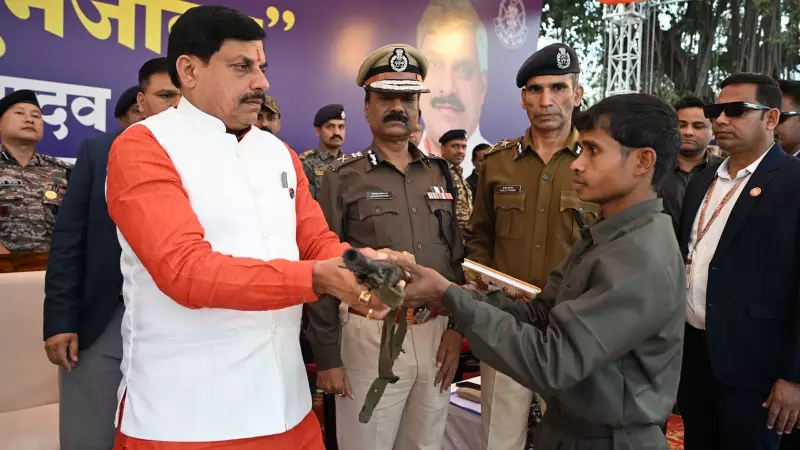
On Sunday, December 8, a formal surrender ceremony was held where the ten Maoists publicly laid down their arms before Chief Minister Mohan Yadav. In a symbolic gesture, they handed over their weapons to the CM, who in return gave them copies of the Indian Constitution. The event concluded with the group singing the national anthem alongside senior ministers and police officials.
The surrendered cache was substantial, underscoring the group's operational capacity. It included:
- Two AK-47 rifles with 137 rounds
- Two INSAS rifles with 40 rounds
- One SLR rifle with 22 rounds
- Additional rifles, ammunition, grenades, detonators, and communication devices
Collapse of a Leadership and the Road to Rehabilitation
The surrender marks the effective collapse of the top leadership of the Kanha-Bhoramdeo (KB) division. Kabir (50), a three-decade veteran who joined in 1995, had risen from being a bodyguard to a senior leader and secretary. His associate, Rakesh Hodi (42), joined in 2002 and was recently elevated to secretary in 2025. Both hail from tribal belts in Chhattisgarh.
The other eight cadres are younger, aged between 26 and 32, and represent newer recruits from Chhattisgarh's Bijapur and Sukma districts, primarily from the Gond tribal community. This includes three women cadres: Salita alias Savitri Alawa (26), Jayshila alias Lalita Oyam (26), and Shilpa Huppo (26).
Their decision to return to the mainstream is incentivized by the Madhya Pradesh Surrender, Rehabilitation and Relief Policy 2023. Under this policy, surrendered Maoists can receive a comprehensive rehabilitation package worth over Rs 35 lakh. This includes cash incentives for surrendering weapons, housing subsidies, skill development training, and financial support for purchasing property and marriage.
Strategic Context and Future Implications
This breakthrough follows intensified security operations launched after the killing of decorated Hawk Force Inspector Ashish Sharma in an encounter on Wednesday near the tri-junction of MP, Maharashtra, and Chhattisgarh. His death triggered a coordinated crackdown by forces from all three states, steadily shrinking the operational space for Maoists in the region.

Security forces have increased their presence in Lanji, Kirnapur, Baihar, and adjoining forest belts touching Gadchiroli (Maharashtra) and Bijapur (Chhattisgarh). Intelligence officials view the surrender as a decisive shift in the anti-Naxal grid, anticipating further lay-downs of arms. This development gains added significance as it aligns with Union Home Minister Amit Shah's deadline to eliminate Maoism from the country by March 21, 2026.
The surrender of Kabir and his associates represents not just a tactical victory but a potential strategic turning point, demonstrating the efficacy of combining confident policing with a persuasive rehabilitation policy to address left-wing extremism.