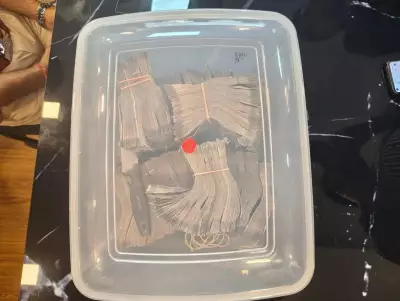
How a Common Tweezer Turned Into a Lethal Weapon on Mumbai's Local Train
What appeared to be a harmless, everyday tool became the instrument of a tragic death in Mumbai last week. A stainless steel tweezer, typically used for delicate tasks like imitation jewelry work or electronics repair, pierced deep into a man's body during an altercation on a crowded local train, leading to fatal consequences that have left medical experts and investigators analyzing how such a small object could prove deadly.
The Incident That Shocked Commuters
According to Mumbai police reports, NM College lecturer Alok Kumar Singh was stabbed on the left side of his abdomen while disembarking from a Borivali-bound train at Malad station. The altercation occurred suddenly in a packed compartment, with the accused, Omkar Shinde, allegedly pulling out the tweezer from his sling bag during the confrontation. Shinde later told investigators he only intended to poke Singh and didn't anticipate the injury could be fatal.
What made this case particularly perplexing was the initial appearance of the wound. Officers noted minimal visible bleeding at the scene, with the external injury appearing relatively minor. This deceptive presentation would later be explained by medical findings that revealed catastrophic internal damage.

Medical Analysis Reveals Catastrophic Internal Damage
The post-mortem examination uncovered the true severity of the injury. The six-inch tweezer had penetrated approximately 12.5 centimeters deep into Singh's body, cutting through multiple layers including skin, muscles, and the abdominal lining before piercing the intestines and major blood vessels.
Dr. Shailesh Mohite, Dean of Topiwala National Medical College and Director of Medical Education for the Municipal Corporation of Greater Mumbai, explained the medical significance: "The presence of approximately 2,500 milliliters of blood and clots inside the abdominal cavity represents nearly half the total blood volume in an adult human body. This massive internal bleeding caused hypovolemic shock, which proved fatal."
Dr. Pramod Bhor, Director of the Orthopaedic Department at Medicover Hospital in Navi Mumbai, added crucial context about the injury's trajectory: "The posterior medial direction of the wound meant it passed through the central abdominal region where major blood vessels are located. The arterial bleeding from these severed vessels led to rapid blood loss, shock, and ultimately death."
Why Abdominal Injuries Can Be Deceptively Dangerous
Medical experts emphasize that abdominal stab injuries present unique dangers compared to wounds in other body areas. Unlike injuries to limbs or the head where bleeding is often immediately visible, abdominal trauma can cause significant internal bleeding while showing minimal external signs.
This deceptive nature means victims may appear stable initially while blood accumulates internally. By the time symptoms become apparent, substantial blood loss may have already occurred, making survival dependent on immediate surgical intervention and emergency care. In Singh's case, damage to both blood vessels and intestines created a perfect storm for rapid, fatal internal bleeding.
The Accused's Explanation and Evidence Recovery
Police investigations revealed that the accused, Omkar Shinde, claimed the tweezer was not carried as a weapon but rather as a tool for his imitation jewelry work. During questioning, he reportedly stated that the argument escalated suddenly, and he acted in anger without considering the potential consequences.
After the stabbing, Shinde allegedly threw the weapon from a railway foot overbridge while fleeing the scene. Investigators later recovered the tweezer from outside Malad railway station, where it became crucial evidence in understanding how this ordinary tool caused such extraordinary damage.

Medical Perspective on Survival Factors
Doctors note that survival in such cases depends on multiple factors beyond just the object used. Dr. Mohite explained: "Many patients with stab or bullet injuries do survive, but factors including the exact injury site, extent of bleeding, speed of hospital admission, and the patient's age all play critical roles. A wound of 12.5 centimeters depth is significant and typically indicates piercing of major blood vessels or organs like the liver or spleen."
The case highlights how even seemingly harmless objects can become deadly when used with force against vulnerable body areas. Medical professionals stress that the danger lies not in the tool itself but in how and where it strikes the human body.
This tragic incident serves as a sobering reminder of how quickly ordinary disputes can escalate with fatal consequences, and how the human body's internal vulnerabilities can turn minor-looking injuries into life-threatening emergencies.