

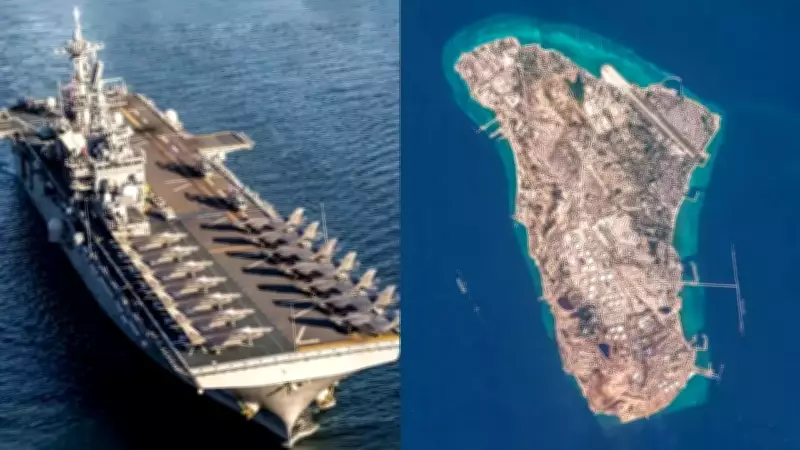
US Prepares 'Boots on Ground' Option for Iran's Kharg Island as USS Tripoli Heads Towards Hormuz
NEW DELHI: The United States is deploying its third warship to the Middle East, with reports indicating a possible movement toward the Strait of Hormuz to position approximately 2,200 Marines for a potential military operation targeting Iran's Kharg Island. This development underscores the escalating tensions involving the US, Israel, and Iran, which are increasingly threatening global oil routes and regional stability.
USS Tripoli: A Mobile Military Base with Amphibious Capabilities
At the center of these strategic maneuvers is the USS Tripoli, an America-class amphibious assault ship designed to transport, land, and support ground troops and their equipment on hostile or foreign shores. According to sources cited by The Wall Street Journal and Sunday Guardian, the ship's deployment has sparked speculation about Washington preparing for a deeper military role in the evolving conflict.
The USS Tripoli is a formidable vessel, measuring around 844 feet in length and functioning as a mobile military base capable of launching simultaneous air and ground operations. It combines the capabilities of an aircraft carrier and a troop transport, carrying advanced aviation assets such as:

- F-35B fighter jets for airstrikes and surveillance
- MV-22 Osprey tilt-rotor aircraft for troop deployment
- MH-60 Seahawk helicopters for logistical missions
This ship is linked to the deployment of the Okinawa-based 31st Marine Expeditionary Unit (MEU), a rapid-response force of 2,200 personnel, as ordered by the Pentagon, according to officials familiar with the plans.
Operational Limitations and Strategic Positioning
Despite its amphibious role, the USS Tripoli cannot operate in shallow coastal waters due to its draft of about 10.7 meters (35 feet), requiring a minimum water depth of 12 to 15 meters. This restricts it from moving close to shorelines, so it remains positioned offshore during operations. From this distance, aircraft and smaller vessels transport Marines and equipment to the shore, allowing the ship to support assaults without exposing itself to shallow-water risks.
Maritime tracking data cited by CNN shows the USS Tripoli recently approaching the Malacca Strait near Singapore and reported south of Sri Lanka, suggesting its movement across the Indian Ocean toward the North Arabian Sea. US Navy vessels often limit public tracking during sensitive deployments but may enable transponders in congested shipping lanes for safe navigation.
Why Kharg Island Is a Critical Focal Point
Kharg Island has emerged as a central element in US strategic calculations due to its pivotal role in Iran's energy and maritime ecosystem. Located in the Persian Gulf, about 25 kilometers off Iran's coast, the island serves as Iran's primary oil export hub, handling nearly 90% of its crude shipments, as reported by Axios. This makes it not only an economic asset but also a geopolitical pressure point directly tied to global energy markets.
Control or disruption around Kharg Island could trigger volatility in global crude prices, given that a significant portion of the world's oil trade passes through the nearby Strait of Hormuz. Securing this corridor is central to US military planning, with options ranging from naval escorts to more aggressive measures involving ground forces, according to Reuters.
The island's symbolic and tactical value is immense; targeting or occupying it would directly impact Iran's revenue streams, potentially limiting its ability to sustain prolonged military operations. However, such a move carries substantial risks, as the island is within range of Iranian missile and drone systems, placing any deployed US Marines in a highly exposed environment. Military experts caution that while Kharg is critical, holding it may not force Iran to concede, especially if Tehran retaliates by disrupting other parts of the supply chain.

Wider Military Planning and Escalation Risks
The movement of the USS Tripoli occurs against the backdrop of expanding military options being considered by the United States as the conflict enters a more uncertain and potentially escalatory phase. The Trump administration is reportedly weighing reinforcing its presence in the Middle East with additional troops and naval assets to enhance operational flexibility, as per Reuters. These deliberations are tied to concrete objectives, including:
- Securing commercial shipping routes through the Strait of Hormuz
- Countering Iran's military capabilities
- Ensuring safe passage of oil tankers through this critical global chokepoint
More aggressive scenarios under discussion involve deploying ground forces along Iran's coastline or at strategic sites like Kharg Island, which would mark a significant escalation from deterrence to direct territorial engagement. The risks are substantial, as any deployment could expose US personnel to Iran's missile and drone capabilities, trigger retaliatory strikes, and widen the conflict. Political risks also exist domestically in the US regarding prolonged military engagements overseas.
Officials emphasize that no final decision has been taken, with all options under consideration. The presence of amphibious platforms like the USS Tripoli provides strategic flexibility, but it also highlights how quickly the situation could shift from positioning to active intervention.
The Bigger Picture: Offshore Power Projection Strategy
The deployment of the USS Tripoli reflects a broader US strategy of projecting military power without direct coastal entry. Modern amphibious ships act as offshore command centers, combining air power, mobility, and troop deployment capabilities to enable rapid-response operations while maintaining a safe distance from hostile coastlines. This approach allows for effective power projection while minimizing risks associated with shallow-water operations.





