Venezuela's Interim President Enacts Sweeping Amnesty Legislation
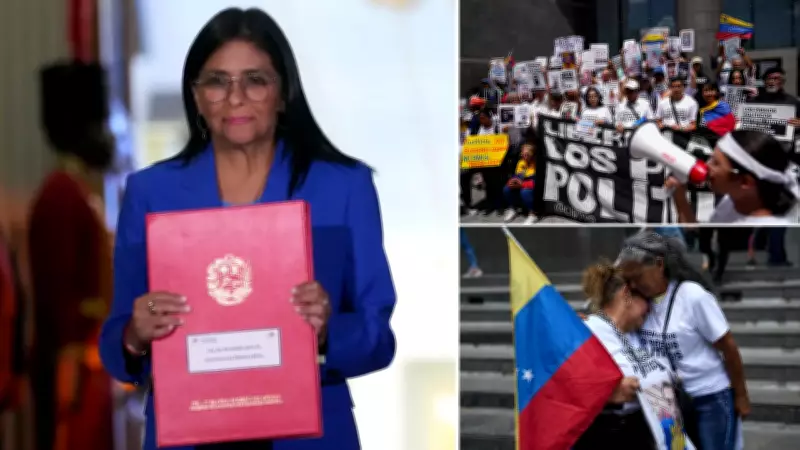
In a significant development for Venezuela's political landscape, Interim President Delcy Rodríguez signed a long-anticipated amnesty bill into law on Thursday. This legislative action creates a legal pathway for the potential release of hundreds of political prisoners who have been incarcerated during recent years of political turmoil.
The Venezuelan parliament had unanimously approved the legislation earlier in the day, following multiple previously postponed sessions. Rodríguez formalized the bill at the historic Miraflores presidential palace in Caracas, presenting the measure as a crucial step toward national reconciliation and healing.
Reconciliation Rhetoric and Political Context
"One must know how to ask for forgiveness, and one must also know how to receive forgiveness," Rodríguez declared during the signing ceremony, emphasizing the symbolic importance of the legislation.

This move occurs against a backdrop of increasing domestic and international scrutiny regarding the treatment and fate of detainees held during the turbulent final years of former president Nicolás Maduro's administration. The amnesty bill represents Rodríguez's most substantial domestic policy initiative since assuming power after Maduro's capture during a US military operation in early January.
Significant Exclusions and Controversial Clauses
Despite its comprehensive scope, the amnesty law contains notable exclusions that could significantly limit its impact. Article 9 explicitly states that individuals prosecuted or convicted for promoting or participating in armed actions, or for facilitating foreign intervention against Venezuela's sovereignty and territorial integrity, will not qualify for amnesty protection.
This provision could potentially affect prominent opposition figures, including Nobel Peace Prize laureate María Corina Machado. The ruling party has previously accused Machado of advocating for international intervention, specifically referencing the US military raid that resulted in Maduro's capture on January 3.
United Nations human rights experts had urged caution prior to the parliamentary vote, emphasizing that the law's scope must be carefully defined. In an official statement from Geneva, UN representatives stressed that the legislation should apply to victims of human rights violations while explicitly excluding those responsible for serious abuses and crimes against humanity, regardless of whether they are state or non-state actors.
Retroactive Application and Historical Coverage
The newly enacted law applies retroactively to 1999, encompassing major flashpoints in Venezuela's contemporary political history. This extensive temporal coverage includes:
- The failed coup attempt against former president Hugo Chávez
- The 2002 oil industry strike that paralyzed the nation's economy
- The 2024 civil unrest that followed Maduro's disputed re-election
For families of detainees, this legislation has raised hopes that their loved ones might soon return home. However, critics express concern that the law could be applied selectively—potentially protecting government allies while denying relief to genuine prisoners of conscience.
Human Rights Concerns and Prisoner Statistics
Human rights organizations estimate that hundreds, possibly thousands, of Venezuelans have been detained in recent years over alleged plots to overthrow Maduro's government. According to reports from news agency AFP, family members have documented numerous cases of torture, mistreatment, and neglect of inmates' medical needs within the prison system.
Citing data from the NGO Foro Penal, these reports indicate that approximately 450 prisoners have been released since Maduro was removed from power, but more than 600 individuals remain in custody. In recent weeks, relatives have organized vigils outside prisons, while a small group in Caracas concluded a nearly week-long hunger strike on Thursday, coinciding with the law's enactment.

Political Backdrop and International Dimensions
Rodríguez assumed the interim presidency following Maduro's capture during the US military operation in January. Her transitional government has operated with the consent of US President Donald Trump, reportedly in exchange for granting Washington access to Venezuela's substantial oil reserves.
On Wednesday, the head of the US military command responsible for operations against alleged drug-smuggling vessels in the region met with Rodríguez in Caracas. The meeting also included Defence Minister Vladimir Padrino and Interior Minister Diosdado Cabello—both long-time Maduro allies known for their staunch anti-imperialist rhetoric.
The implementation of this amnesty legislation will likely serve as an early test of the interim administration's commitment to reconciliation in a nation that remains deeply polarized. As Venezuela navigates this complex political transition, the world watches closely to see how this significant legal development will unfold in practice.