

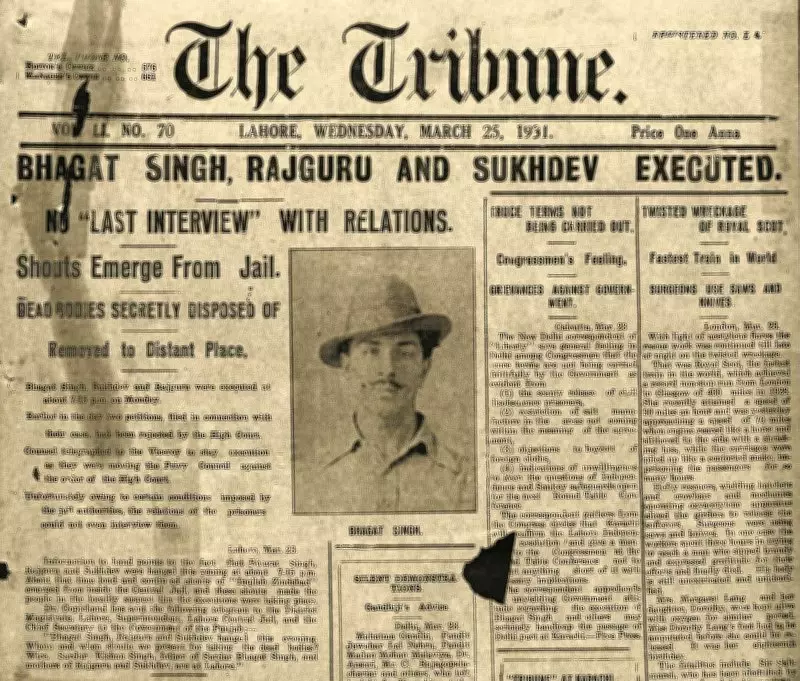
The Unfinished Argument of 1931: A Revolutionary Challenge Echoes Through History
In the final weeks before their execution, Bhagat Singh, Sukhdev, and Rajguru mounted a profound challenge that transcended mere confrontation with the colonial state. Their actions and writings pierced the moral boundaries of nationalist politics, revealing a deep ideological conflict at the heart of India's freedom struggle. As the Gandhi-Irwin Pact brought deceptive calm to the political landscape, a fierce struggle unfolded within the prison walls of Lahore, where these revolutionaries faced not only British oppression but also what they perceived as abandonment by the nationalist movement.
The Gandhi-Irwin Pact and Its Moral Cost
The Gandhi-Irwin Pact, signed on March 5, 1931, was celebrated within Congress circles as a significant diplomatic achievement. It secured the release of thousands of Civil Disobedience prisoners, restored confiscated properties in numerous cases, and lifted restrictions on non-violent political activities. However, its limitations were stark and unmistakable. Those accused of revolutionary violence were deliberately excluded from its provisions. The colonial government had long maintained a distinction between "political prisoners" and "terrorists," and the Pact implicitly accepted this categorization.
The result created a troubling hierarchy within the freedom struggle itself. One stream of resistance received recognition and negotiation, while another was left completely outside the realm of political discourse. While Gandhi negotiated for satyagrahis, Bhagat Singh and his comrades—along with countless other revolutionaries who had endured years in prison—remained beyond any scope of clemency. This decision, born from ideological conviction and political strategy, carried a profound moral cost that would reverberate through history.

Sukhdev's Pen: The Voice of Betrayal and Ideological Clarity
No one articulated this sense of betrayal more powerfully than Sukhdev, one of the most disciplined organizers of the Hindustan Socialist Republican Association. During his final months in prison, he used his writing to reflect critically on the direction of the nationalist movement. In an intercepted letter from October 1930, he expressed both excitement about the spread of revolutionary impulse beyond Punjab and frustration that political leaders and the press only acknowledged revolutionary seriousness after arrests and trials forced their hand.
By December 1930, his anxiety had crystallized into a warning about revolutionary language becoming empty rhetoric. He insisted that revolution needed to be explained to the masses in concrete terms—not merely as a transfer of political power, but as a transformation of social relations. Without this clarity, he feared the language of revolution would be absorbed into a nationalism devoid of social purpose.
On the very day the Gandhi-Irwin Pact was signed, Sukhdev penned one of his most striking letters, accusing Congress leaders of suppressing a revolutionary statement issued on March 3 because it criticized Gandhi and other senior figures. "We are being strangled by these high-class leaders," he wrote in a phrase that still shocks with its intensity. What emerges from this correspondence is not a rejection of the nationalist movement itself, but a decisive break with what he perceived as its compromised moral center.
The Uncomfortable Exchange with Gandhi
The conflict reached its sharpest point in Sukhdev's letter to Gandhi, delivered through his uncle Chint Ram Thapar after a jail visit in mid-March. This communication posed uncomfortable questions that cut to the heart of the freedom struggle: Why had Gandhi's movement remained silent about revolutionaries who had spent years in prison? Was freedom to be won only for Congressmen? Gandhi received the letter and published it in Young India, but his reply remained cautious and evasive, insisting he had done what he could while avoiding any direct demand for clemency.

This exchange revealed a fundamental divide within Indian nationalism. Gandhi's politics rested on the absolute primacy of non-violence as both method and moral principle. The revolutionaries argued that the anti-colonial struggle had manifested in multiple forms and that abandoning one stream of sacrifice would damage the moral integrity of the entire national cause.
A National Fracture Beyond Punjab
The discontent was not confined to Punjab alone. Revolutionary networks across India expressed similar frustrations. An intercepted letter from a Bengali revolutionary connected with the Chittagong uprising suggested that Bengal's militant energy during the Civil Disobedience movement owed much to the revolutionary underground. These voices indicate a deeper fracture within the nationalist movement—a schism that would shape India's political consciousness for generations.
The Final Intervention: A Revolutionary Ethic Defined
It was in this charged atmosphere that Bhagat Singh, Sukhdev, and Rajguru made their final, remarkable intervention. In their letter to the Governor of Punjab, they did not beg for mercy. Instead, having been convicted of waging war against the Crown, they demanded to be treated as soldiers and executed by firing squad rather than by hanging. As reported in The Tribune (Lahore) on March 23, 1931, their letter stated: "The only thing we want to point out is that according to the verdict of your Court, we are said to have been waging war and are consequently war prisoners. Therefore, we claim to be treated as such, i.e., we claim to be shot dead instead of being hanged."
This was an act of extraordinary political clarity. The colonial state had convicted them of waging war; the revolutionaries turned this charge into a powerful argument. If this were indeed war, they would not be criminals but political combatants. If the British government insisted on the language of war, it had to accept all its implications.
The phrase "come and shoot us" condensed an entire revolutionary ethic. It was neither theatrical nor romantic, but a profound refusal to allow the colonial state to define their political identity. By demanding death as soldiers, they asserted dignity over pity and agency over victimhood. Their words reveal the intellectual seriousness of the revolutionary movement—Bhagat Singh repeatedly insisted that revolution was not a cult of bomb and pistol but a struggle for justice and equality.
Legacy of Unanswered Questions
These writings challenge the comforting myth that India's freedom movement spoke with a single moral voice. Beneath the broad front against the British Empire existed competing visions of resistance, legitimacy, and the future nation. On March 23, India observes Martyrs' Day in memory of Bhagat Singh, Sukhdev, and Rajguru. While commemoration often takes the form of homage, the deeper tribute lies in remembering the questions they forced the nation to confront: What kind of freedom was being sought? Who would be included within its moral horizon? Could a national movement afford to forget those who had fought and died outside its accepted methods?
Their execution in Lahore Central Jail did not silence these questions. If anything, it amplified them. The voices the colonial state tried to extinguish continue to echo across generations, reminding the nation that freedom was not achieved by one path alone. The revolutionaries of 1931 remain among the most uncompromising witnesses to the unfinished promise of justice—their argument still resonating in contemporary discussions about political morality, sacrifice, and the true meaning of liberation.





