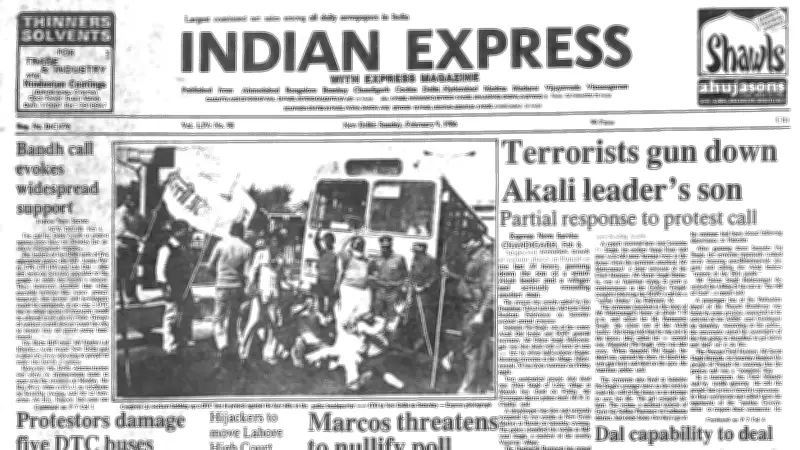
February 9, 1986: A Day of Violence, Diplomacy, and Protest in India
Forty years ago, on February 9, 1986, India witnessed a confluence of tragic violence, high-level diplomatic appeals, and widespread civil protest. The front page of The Indian Express from that date chronicled these pivotal events, capturing a nation grappling with internal security challenges and economic pressures.
Terrorist Attacks Rock Punjab: Akali Leader's Son Assassinated
In a series of coordinated strikes across Punjab, suspected terrorists unleashed violence over a 24-hour period, resulting in multiple casualties. The most prominent victim was Satinder Pal Singh, son of a senior Akali Dal leader, who was shot dead by approximately half a dozen assailants shouting slogans. This targeted killing underscored the volatile security situation in the state during that era.
Additionally, a villager was gunned down, and another man sustained serious injuries in separate incidents. Reports indicated several other violent occurrences throughout the region, with one further casualty noted in Loha village. The day had been marked as a protest day, jointly called by the Damdami Taksal and the All-India Sikh Students Federation, which evoked a partial response from the public, highlighting the tense communal and political atmosphere.

Prime Minister Rajiv Gandhi Appeals for Global Economic Dialogue
On the international stage, Prime Minister Rajiv Gandhi addressed pressing global economic concerns. He called for an early resumption of the North-South dialogue, describing the world as facing its "most serious economic crisis" since the 1930s. Gandhi expressed regret that a hostile international climate was impeding the efforts of developing countries, particularly those in South Asia, to consolidate their independence and strengthen their economies.
Furthermore, the Prime Minister highlighted a concerning trend: the diminishing role of the United Nations in matters of peace and security. His statements reflected India's active engagement in global diplomacy and its advocacy for a more equitable international order during a period of economic uncertainty.
Government Considers Income Tax Exemption for Homeowners
In domestic policy developments, the government was examining a proposal to boost house building activity across the country. The initiative, mooted by the Ministry of Urban Development, sought to exempt owners of self-occupied houses from income tax. This move came in response to recommendations from a large number of state governments, aiming to stimulate construction and address housing needs, signaling an early focus on urban development and economic incentives.
Delhi Bandh Successfully Protests Price Hikes
Meanwhile, in the national capital, a Delhi bandh (shutdown) called to protest against rising prices saw widespread success. Leaders from the Delhi units of five opposition parties—the BJP, Janata Party, CPI, CPI(M), and Lok Dal—appealed to citizens to support the bandh, ensuring a significant impact.
The organizers clarified that while essential services such as water supply, electricity, hospitals, fire services, and newspapers would be exempted, public transport, including DTC buses, would not be allowed to operate. Additionally, workers were deployed to ensure that petrol pumps remained closed, demonstrating a coordinated effort to amplify the protest's message against inflation and economic hardship.
This snapshot from February 9, 1986, reveals a India at a crossroads, dealing with internal strife, engaging in global economic discussions, and witnessing public mobilization against governance issues—themes that continue to resonate in contemporary discourse.