

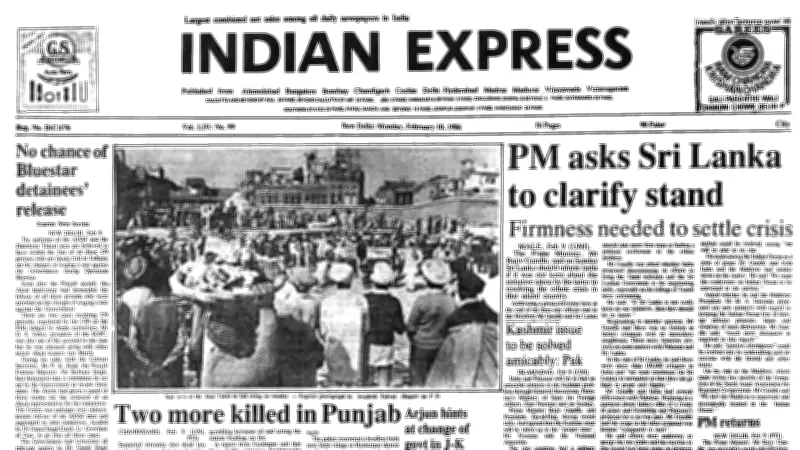
February 10, 1986: A Day of Violence, Diplomacy, and Legal Moves in India
On this day forty years ago, the front page of The Indian Express captured a nation grappling with internal strife and international diplomacy. The headlines revealed a tragic incident in Punjab, significant legal discussions with Britain, and Prime Minister Rajiv Gandhi's stance on Sri Lanka's ethnic crisis.
Punjab Sees Fresh Violence as Two Killed in Ferozepur District
In a disturbing escalation of violence, suspected terrorists struck in Punjab, resulting in the deaths of two individuals and serious injuries to another. The attack occurred in the village of Khai, near Ferozepur, where four assailants armed with a sten gun and revolvers opened fire. The victims were identified as Nazar Ram and Sher Singh, both fatally shot, while Bohar Singh sustained serious injuries and was hospitalized.
The perpetrators managed to escape the scene, and as of the report, no arrests had been made. In a separate but related incident, a railway station near Ludhiana was set ablaze, though no casualties were reported from that fire. These events underscored the ongoing security challenges in the region during a period marked by heightened tensions.

India Presents Draft Extradition Treaty to Britain for Terrorist Trials
In a strategic legal move, the Indian government presented a draft extradition treaty to Britain. This initiative aimed to facilitate the extradition of terrorists from Britain to India, allowing them to face trial in Indian courts. Legal experts from both nations had been engaged in discussions to establish a framework for handling such cases, with the latest round of talks concluding in New Delhi in January 1986.
The treaty was seen as a crucial step in strengthening international cooperation against terrorism, with plans for further meetings to refine the arrangement. This development highlighted India's efforts to leverage diplomatic channels to address cross-border security threats.
Prime Minister Rajiv Gandhi Urges Sri Lanka on Ethnic Crisis Resolution
During a press conference in Male, Maldives, at the end of his three-day official visit, Prime Minister Rajiv Gandhi addressed the ethnic crisis in Sri Lanka. He emphasized that Sri Lanka should inform India if it was not interested in the initiatives India had taken to resolve the conflict. Gandhi called for more decisive steps from Sri Lanka in finding a political settlement to the ethnic problem, reflecting India's active role in regional diplomacy.
His comments came amid ongoing efforts to mediate and support peace talks, underscoring the complexities of South Asian geopolitics at the time.
Operation Bluestar Detainees Face Trial Amid Political Demands
The legal proceedings for 379 individuals charged with waging war against the government during Operation Bluestar continued, with their fate believed to be influenced by the activities of groups like the All India Sikh Students Federation (AISSF) and the Damdami Taksal. Following the Punjab accord, Akali leadership had demanded the release of all those arrested on such charges.
These cases, registered by the Central Bureau of Investigation (CBI) based on FIRs lodged by Army authorities, involved two separate trials. Notably, G S Tohra, president of the Shiromani Gurdwara Parbandhak Committee (SGPC), was among the accused in one case but had been released along with other senior Akali leaders in March 1985. This situation highlighted the intertwining of legal, political, and social factors in post-Operation Bluestar Punjab.
Overall, February 10, 1986, was a day that encapsulated India's struggles with internal security, its diplomatic engagements abroad, and the lingering aftermath of significant military operations. The events reported in The Indian Express serve as a historical snapshot of a nation navigating multiple fronts during a turbulent era.






