

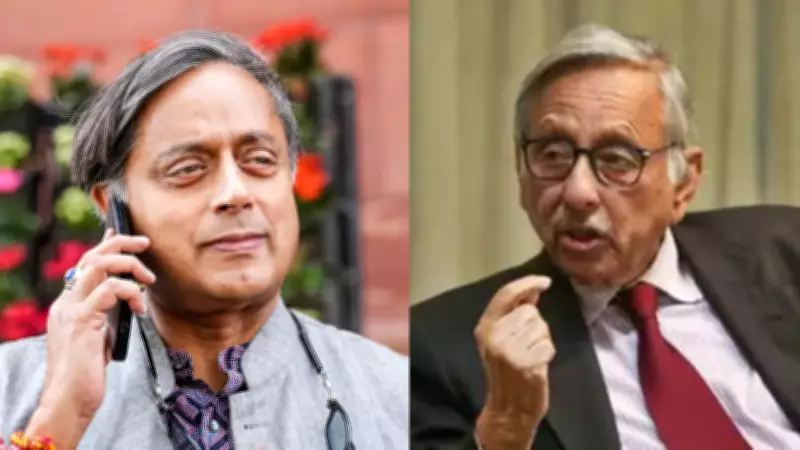
Congress Leaders Aiyar and Tharoor Engage in Heated Public Spat Over Foreign Policy
A significant public confrontation unfolded on Thursday between senior Congress leaders Mani Shankar Aiyar and Shashi Tharoor, as they exchanged sharply-worded open letters addressing critical issues of foreign policy, ideological alignment, and personal conduct. This dispute has brought to light deep-seated divisions within the party, sparking widespread political discourse.
Aiyar's Open Letter: Criticism and Regret
The confrontation was initiated when Mani Shankar Aiyar published an open letter in Frontline magazine, directed at Shashi Tharoor. Aiyar expressed being "shocked to the core" by Tharoor's remarks during a television discussion on the ongoing conflict involving Iran, Israel, and the United States. He revealed that the issue disturbed him so profoundly that he woke up in the early hours to compose the message.
Recalling the Congress presidential election, Aiyar noted that he had supported Tharoor's candidature despite anticipating his loss to Mallikarjun Kharge. He also mentioned advocating for Tharoor to receive an honourable position within the party hierarchy post-defeat. However, Aiyar now expressed regret over this support, accusing Tharoor of endorsing a "might is right" approach in international affairs and being overly cautious in criticising the United States due to potential economic repercussions for India.

Aiyar further questioned Tharoor's effectiveness as chairman of Parliament's Standing Committee on External Affairs, arguing that deferring foreign policy decisions to the government undermines the committee's purpose. Additionally, he criticised Tharoor's past stance on the Sabarimala Temple entry issue, suggesting it raised doubts about his ideological consistency with the party. Concluding his letter, Aiyar declared a "parting of ways", indicating that their differences had reached an irreconcilable point.
Tharoor's Response: Defense and Rebuttal
Shashi Tharoor responded with his own open letter, published by NDTV, firmly rejecting Aiyar's accusations and defending his viewpoints. He acknowledged that disagreement is natural in a healthy democracy but criticised Aiyar for questioning his motives and character, which he deemed inappropriate.
Tharoor asserted that his perspectives on international affairs are rooted in a "clear nationalist perspective", emphasising that weighing geopolitical realities and economic consequences for India should be seen as responsible policymaking rather than a moral compromise. He wrote, "No generation holds a monopoly over patriotism, nor over the interpretation of Gandhi or Nehru. The true tribute to their legacy lies in applying their values wisely to the realities of our time."
In response to Aiyar's remarks about his foreign travel, Tharoor dismissed them as baseless, clarifying that his trips abroad, except for participation in an all-party delegation linked to Operation Sindoor, were undertaken in a personal capacity without government arrangement or funding. Addressing the Sabarimala issue, Tharoor stated that he had supported the Congress party's official stand and had previously explained his position in detail.
While acknowledging Aiyar's support during the Congress presidential election, Tharoor highlighted that he too had defended Aiyar in the past, particularly when the veteran leader faced disciplinary action within the party. He wrote, "I, too, supported you very strongly with the 'high command' of the party, especially when you were suspended from its membership. I have no regrets that that injustice has been reversed."
Tharoor concluded by arguing that Aiyar's claim of a "parting of ways" was disingenuous, as the break had already become evident through repeated personal remarks directed at him in recent months.
Implications and Broader Context
This public spat underscores ongoing tensions within the Congress party regarding foreign policy and ideological coherence. The exchange of open letters not only highlights personal differences but also reflects broader debates on India's stance in global affairs, especially concerning conflicts like the Israel-Iran war and relations with major powers such as the United States.

As both leaders stand firm in their positions, this episode may influence internal party dynamics and public perception, potentially impacting future policy discussions and electoral strategies. The detailed rebuttals and accusations serve as a reminder of the complex interplay between personal convictions and political responsibilities in a democratic setup.





