

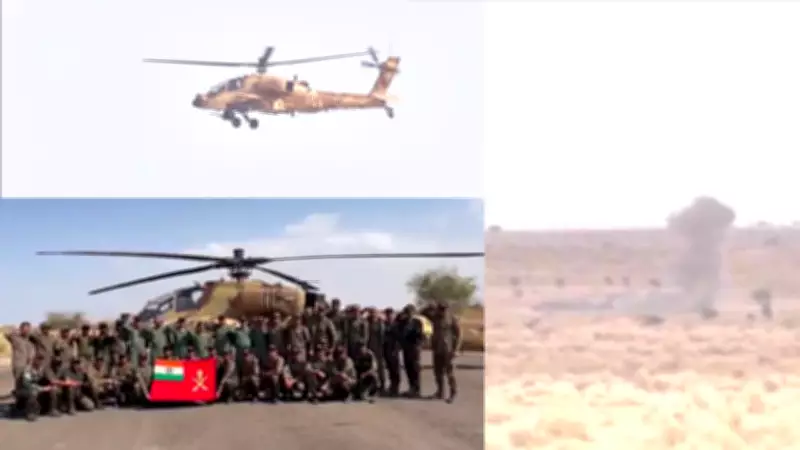
Indian Army Demonstrates Advanced Combat Capabilities with Apache Helicopters in Pokhran
The Indian Army recently showcased its formidable firepower and cutting-edge combat capabilities during Exercise Brahmastra at the Pokhran Field Firing Range in Jaisalmer. This major display was spearheaded by AH-64E Apache attack helicopters, emphasizing the Army's growing focus on integrating aerial platforms with ground operations to enhance battlefield effectiveness.
Precision Strikes and Live Fire Drills in Desert Terrain
Popularly referred to as "tanks in the air", the Apache helicopters demonstrated exceptional precision strike capability by successfully launching AGM-114 Hellfire missiles, rockets, and executing live gunfire drills. The exercise marked a significant operational milestone, proving the platform's ability to deliver accurate and lethal strikes in complex combat environments.
An Army official described how the desert landscape of Jaisalmer echoed with the intensity of modern warfare as the skies illuminated with sustained firepower. Flying at very low altitudes over challenging desert terrain, the Apaches conducted precise target engagements, reflecting advanced tactical maneuvers and high pilot proficiency.

Leadership Involvement and Indigenous Developments
In a notable development, Chief of Army Staff General Upendra Dwivedi flew a sortie on the indigenous Light Combat Helicopter Prachand at Hindustan Aeronautics Limited in Bengaluru just a day before the field demonstration. This was followed by the Apache's inaugural field firing at Pokhran, where it effectively engaged targets using Hellfire missiles and other onboard weapon systems.
Officials emphasized that the coordinated operations illustrated how attack helicopters can seamlessly collaborate with ground forces, even in high-threat scenarios involving small arms fire, shoulder-fired missiles, and drone threats. Equipped with advanced sensors, fire control systems, and real-time data links, the helicopters showcased rapid target detection and precise strike capabilities.
Expert Insights on Modern Warfare and Preparedness
Brigadier P. K. Singh, Brigade Commander, detailed the extensive preparation behind the exercise. "During this firing exercise, our pilots conducted simulator training, mission planning, and target engagement drills. Our technical teams ensured that all helicopters and weapon systems were fully operational. The successful firing validated the accuracy, combat capability, and preparedness of these platforms," he stated.
He further explained that in modern network-centric warfare, attack helicopters play a crucial role in providing immediate fire support to land forces. "The induction of Apache, Prachand, and Rudra helicopters has significantly strengthened our combat capabilities. Our pilots combine courage, skill, and technical expertise, ensuring an edge in future conflicts," he added.
Colonel Vikrant Sharma, Commanding Officer of Apache 451 Squadron, highlighted the operational importance of these platforms. "Apache helicopters bring strong operational capability, combining precision firepower with advanced sensors and the ability to operate in dynamic battlefield conditions," he noted.
He also mentioned that as battlefields become increasingly complex, Apache helicopters enhance responsiveness and operational reach. The demonstration at Pokhran reinforced the Indian Army's commitment to stronger air-land integration and readiness for modern combat scenarios, offering a clear glimpse into its technological strength and ability to handle evolving threats.






