

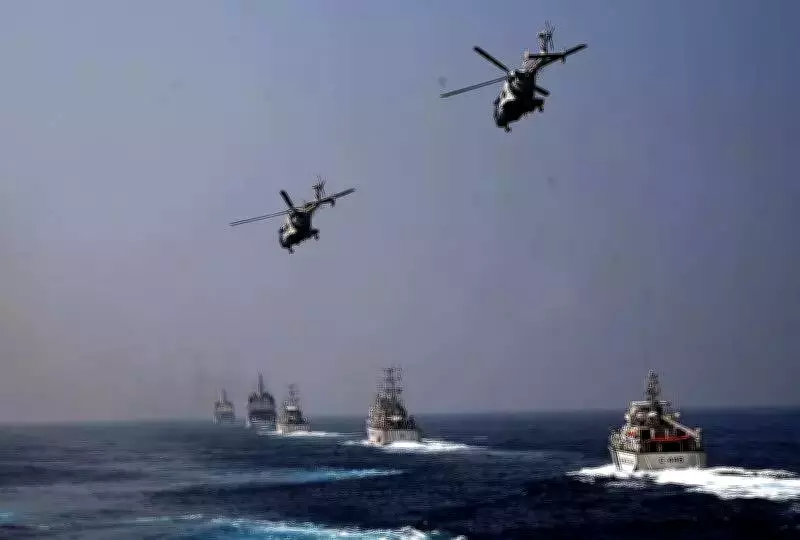
Indian Army Launches Joint Control Centre in Sensitive Sir Creek Region
The Southern Command of the Indian Army has established a comprehensive joint control centre in the strategically vital Sir Creek region, marking a significant advancement in military coordination. This facility is specifically designed to enhance seamless integration and real-time information sharing among the Army, Navy, Indian Air Force, Coast Guard, and the Border Security Force (BSF).
Emphasis on Integrated Operations and Strategic Coordination
This strategic move underscores the growing emphasis on integrated military operations and enhanced situational awareness in complex border environments. The initiative follows the critical lessons learned from Operation Sindoor, which highlighted the absolute necessity of flawless coordination among multiple agencies operating across land, sea, and air domains in the Western sector.
A senior Army officer explained to TOI, "The facility aims at synergising multi-source sensor inputs across the region to deliver a unified surveillance picture and enhanced situational awareness for ground commanders." The officer stressed that jointness among services was no longer merely optional but had become operationally critical for national security.

Government Recognition and Strategic Importance
Defence Secretary Rajesh Kumar Singh personally visited the newly established centre on Tuesday, underlining the strategic importance the government places on integrated command and control structures in sensitive frontier regions. This high-level visit demonstrates the national priority given to strengthening defense coordination mechanisms.
The Operational Challenges of Sir Creek
Sir Creek, a 96-kilometer marshy, salt-encrusted strip separating India and Pakistan in Gujarat's Kutch region, has long been regarded as one of the most operationally challenging and strategically sensitive areas along the western border. Its difficult terrain, complex tidal creeks, and proximity to the Arabian Sea make it particularly vulnerable to infiltration attempts, smuggling activities, and potential maritime security threats.
An officer with previous service experience in the region elaborated, "Its proximity to key naval and air bases, vital coastal installations, and its vulnerability as a potential route for infiltration make it a critical frontier for both surveillance and deterrence." Given these multifaceted complexities, traditional siloed operations by individual military services were deemed insufficient for contemporary security requirements.
Modern Warfare Testing Ground
"With the evolving nature of modern warfare, the Sir Creek region provides an ideal testing ground for tri-service coordination," another senior Army officer stated. "The terrain demands exceptional agility, constant inter-service communication, and technological adaptability, all of which this centre is specifically designed to strengthen."
Comprehensive Surveillance Integration
The joint control centre brings together intelligence inputs from diverse sources including ground sensors, advanced maritime surveillance systems, aerial reconnaissance platforms, and multiple intelligence agencies. This integrated approach enables commanders to respond faster and more decisively to emerging threats with comprehensive situational awareness.
Enhanced Capabilities Beyond Security Operations
Officials confirmed that the centre also significantly enhances coordination during joint military exercises, disaster response operations, and coastal defense missions, ensuring that all agencies operate from a shared operational picture. According to defense sources, experiences from recent operations, including Operation Sindoor, reinforced the need for institutionalized joint mechanisms rather than relying on ad hoc coordination.
A knowledgeable source emphasized, "The Sir Creek and adjoining coastal sectors are among the most operationally demanding environments. It is essential to have coordinated efforts to tackle varied security challenges, ranging from infiltration and smuggling to unconventional maritime threats."

Validation Through Joint Exercises
Conducting large-scale joint exercises in the region allows defense forces to validate amphibious capabilities, coastal defense preparedness, and inter-service communication under realistic combat conditions. "Such integration not only improves operational effectiveness but also reinforces deterrence against potential adversaries," a military officer concluded, highlighting the broader strategic implications of this coordinated approach.





