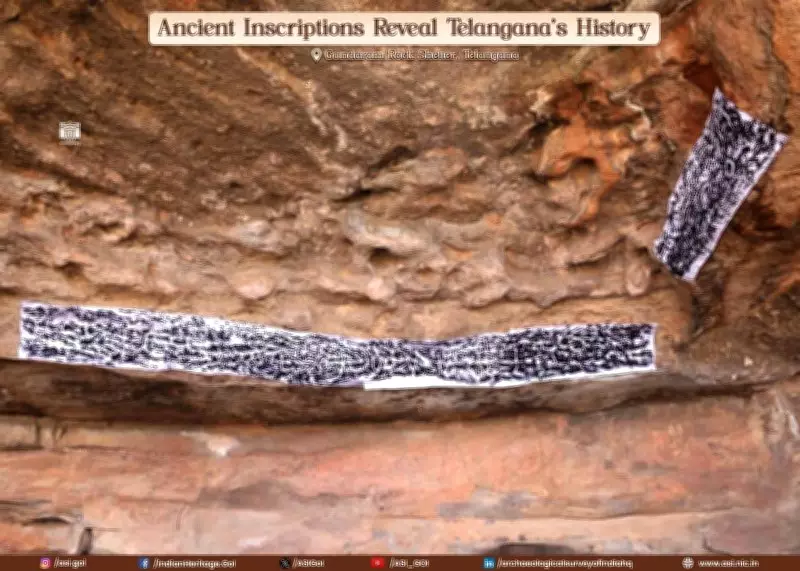
The Archaeological Survey of India (ASI) has discovered two rare Brahmi inscriptions at the Gundaram rock shelter in Peddapalli district, Telangana, offering fresh insights into the region's early history, the Satavahana period, and the spread of Buddhism.
Details of the Inscriptions
Dated to the 1st century BCE, the inscriptions are written in Prakrit and were found on the rock shelter's walls. One inscription records that a member of the Hāritiputra lineage, likely from the Chuṭu dynasty and a friend of Satavahana prince Kumāra Hakusiri, excavated the cave for Buddhist monks. This suggests a close link between the Chuṭus and the Satavahanas, according to an ASI official.
The second inscription states that the area east of the hill was under the authority of Siri Devarāna. It also features engravings of a trident and damaru (drum), making it the earliest known inscription in South India to include these auspicious Hindu symbols alongside the text.

Religious Significance
The ASI noted that these epigraphical discoveries trace the widespread influence of Buddhism across the Deccan plateau. The presence of inscriptions from two distinct religious traditions at the same site—Buddhist in the 1st century BCE and later Hindu symbols—offers a compelling account of religious evolution. The official explained that Buddhism flourished in the 1st century BCE before gradually declining by the 6th century CE with the rise of Hindu sects such as the Kalamukhas.
Context of Brahmi Script
The Brahmi script is the earliest major writing system developed in ancient India and the ancestor of nearly all modern South Asian scripts, including Devanagari, Tamil, Telugu, and Bengali. It is a semi-alphabetic script written from left to right. The best-known Brahmi inscriptions are the rock and pillar edicts of Mauryan emperor Ashoka, found across the subcontinent, such as the Girnar Rock Edict in Gujarat and the Dhauli Edicts in Odisha.
Impact on Research
These findings deepen the understanding of the Deccan's dynamic religious history and open new avenues for archaeological and cultural research in Telangana. Telangana is home to a rich array of early Brahmi inscriptions on rock shelters, caves, and boulders, most dating from the 3rd century BCE to the 1st century CE, documenting ancient Buddhist heritage and early dynasties like the Satavahanas.