

Assam's Final Electoral Rolls Show Rare Contraction Amid Historic Gender Parity
Guwahati: In a significant development for India's northeastern state, Assam's final electoral rolls published on Tuesday revealed a rare contraction from the draft list, with more than 2.43 lakh names removed during the special revision process. Despite this purification effort, the state's electorate has reached a monumental milestone of nearly 2.5 crore voters, representing an increase of over one crore in the past quarter century.
Rigorous Purification Process Leads to Decrease
In percentage terms, the final electoral rolls recorded a 0.97% decline compared to the draft rolls published in December last year. Election officials have attributed this decrease to a more rigorous purification process that systematically eliminated duplicate entries and removed names of deceased voters from the electoral database.
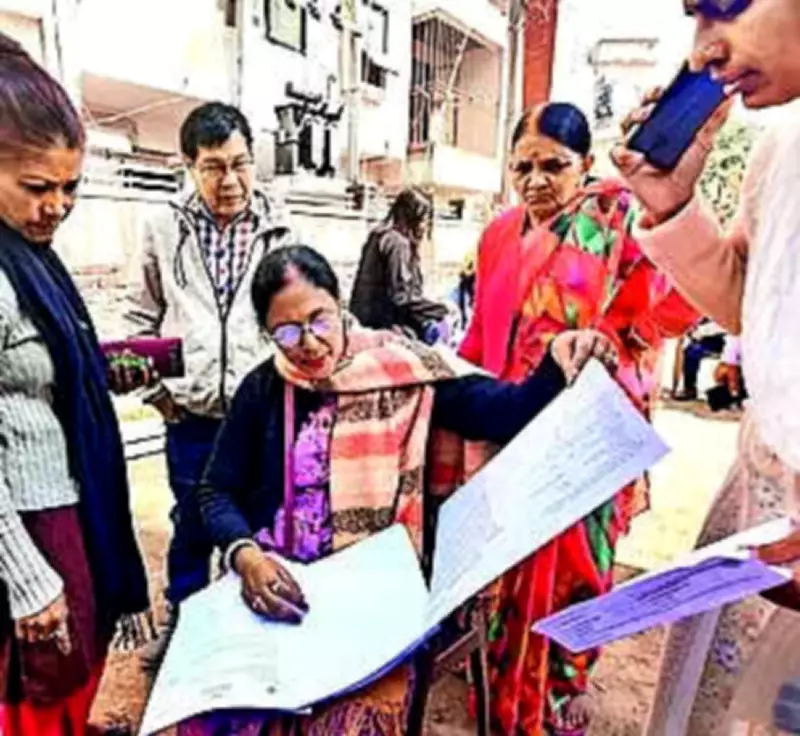
"If one has to justify the decrease in the number of voters compared with the draft rolls, it is because in earlier summary revisions the draft rolls were updated based largely on voluntary information — such as reports of deaths, new eligibles, or voters shifting residence on their own," explained an official involved in the process. "This time, during the special revision, we went house-to-house to update the draft voters' list, and hence the rolls underwent greater purification."

Historic Gender Balance Achieved
The most striking feature of the final electoral rolls is the unprecedented gender balance achieved after decades of male dominance. Assam is entering its first election cycle with near-perfect gender parity, with women accounting for 49.9% of the electorate, trailing men by only about 6,630 voters.
This represents a dramatic shift from historical patterns where the male-female gap consistently hovered between five lakh and seven lakh voters. The transformation has been particularly remarkable in recent years:
- In 2001, men outnumbered women by over five lakh voters
- By 2016, the gap had widened to 6.78 lakh
- The tide began to turn in 2021, when women narrowed the gap down to 3.22 lakh
- Now, in 2026, the gap stands at just 6,630 voters
Quarter Century of Electorate Transformation
Over the past twenty-five years, Assam's electorate has undergone a remarkable transformation that reflects both demographic changes and sustained enrolment drives. From 1.4 crore voters in 2001, the rolls have expanded to nearly 2.5 crore in 2026, registering an impressive 73% growth overall.
The expansion has occurred at varying paces across different periods:
- The biggest surge came between 2001 and 2006, when the rolls grew by more than 20%
- The slowest phase was between 2006 and 2011, with growth of just over 4%
- More recently, the electorate expanded by 15.7% between 2016 and 2021
- The latest cycle shows a moderated growth of 8.6%
Dual Story of Expansion and Inclusion
Taken together, Assam's electoral journey tells a compelling dual story: steady expansion of the voter base alongside a dramatically narrowing gender gap. The numbers reflect not just demographic growth, but a fundamental reshaping of the electorate itself — one that is larger, more inclusive, and more balanced than ever before in the state's history.
Meanwhile, election officials have clarified that eligible voters whose names were deleted from their previous polling stations or constituencies on the grounds of having 'permanently shifted' from their earlier places of residence due to evictions or other reasons can now apply for inclusion at their new addresses. This provision ensures that genuine voters are not disenfranchised during the purification process.
The comprehensive house-to-house verification during the special revision has created what officials describe as the most accurate and purified electoral database in Assam's recent history, setting a new standard for electoral integrity in the region.






