

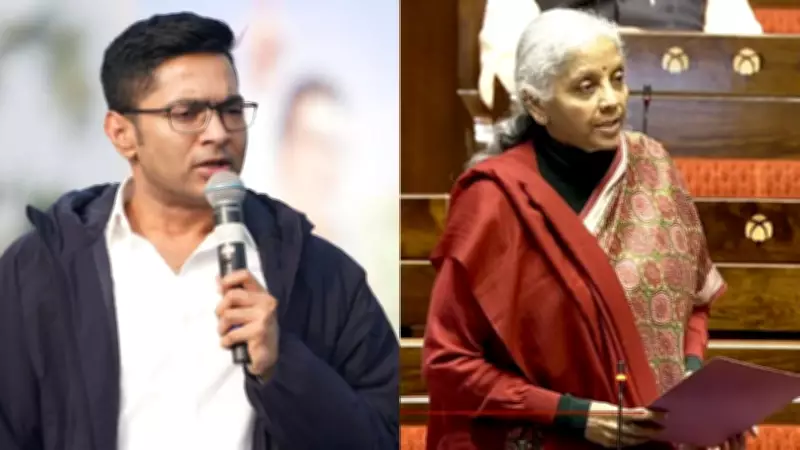
Abhishek Banerjee Delivers Sharp Retort to Nirmala Sitharaman on GST and Budget Issues
In a fiery exchange over the Union Budget, Trinamool Congress (TMC) MP Abhishek Banerjee launched a scathing critique against Union Finance Minister Nirmala Sitharaman, accusing her of failing to grasp the real-world impact of GST on impoverished households. The clash erupted after Sitharaman dismissed Banerjee's parliamentary statements as "distorted facts," prompting a robust defense from the TMC leader.
Background of the Parliamentary Dispute
The controversy began when Abhishek Banerjee raised concerns in the Lok Sabha about West Bengal being overlooked in the Union Budget. In response, Nirmala Sitharaman addressed the Opposition's criticism, specifically targeting Banerjee for what she termed misleading claims. She emphasized that since GST's introduction in 2017, essential items like milk, education materials, and healthcare have been exempt from tax, questioning the basis of his assertions.
Banerjee's Detailed Rebuttal on GST Implications
Abhishek Banerjee released a statement countering Sitharaman's remarks, thanking her for listening but urging her to pay equal attention to the grievances of Bengal's residents regarding unpaid dues under schemes like MGNREGA and PMAY. He elaborated on the GST discrepancies, pointing out that while fresh liquid milk is tax-free, powdered milk—often a necessity for struggling families—carries a 5% GST levy.

Furthermore, Banerjee highlighted that although medical consultations are GST-exempt, critical supplies such as oxygen cylinders for Covid patients are taxed at 12%, insulin injections at 5%, and anesthesia at 12%. He argued that this disconnect between policy and practicality underscores a broader issue of governance.
The Core Argument: Two Indias in Perception
In his closing remarks, Banerjee starkly contrasted perspectives, stating, "Until you understand the difference between what's written in the GST Act and what's written on a poor family's grocery bill, you'll keep living in your India while we live in ours." This phrase encapsulates his critique of Sitharaman's approach, suggesting a gap between theoretical accuracy and on-ground realities for vulnerable populations.
The debate has ignited discussions on GST implementation and budget allocations, with Banerjee's comments resonating among critics of current economic policies. As political tensions simmer, this exchange highlights ongoing friction between the ruling party and opposition over fiscal matters and social welfare.






