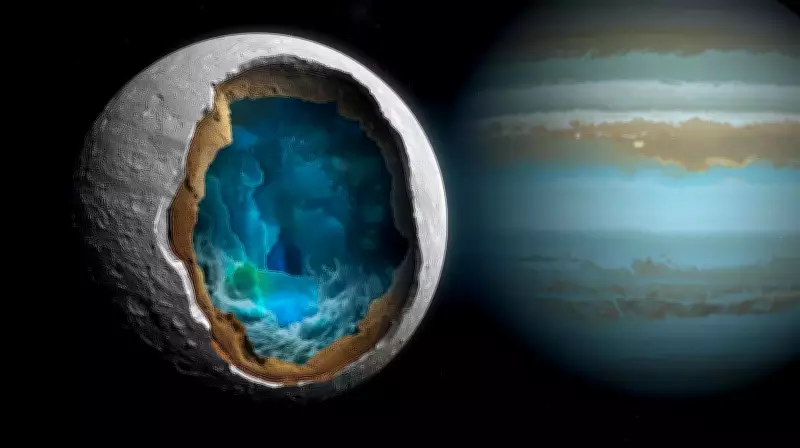
Uranus Moon Miranda's Geological Secrets Point to Ancient Ocean
Miranda, one of Uranus' enigmatic moons, defies expectations with its complex surface geology. Unlike typical small moons, Miranda displays dramatic scars and features that appear disproportionate to its modest size. These characteristics were first observed in detail during the Voyager 2 spacecraft's historic flyby in 1986, which provided the only close-up images of this distant world.
Unusual Surface Features and Coronae Structures
The moon's surface reveals wide fault systems cutting across older, heavily cratered terrain. Most strikingly, three large regions known as coronae interrupt the landscape with distinctive ridges and grooves that appear geologically younger than their surroundings. A groundbreaking peer-reviewed study published in The Planetary Science Journal has re-examined these mysterious structures using advanced geological mapping techniques and sophisticated computer stress models.
Researchers focused their investigation on determining the possible thickness of Miranda's ice shell and whether a subsurface ocean could have existed in the moon's relatively recent geological past. Their comprehensive analysis suggests Miranda likely possessed a thin outer ice shell and may have harbored deep liquid water long after its initial formation.

Contrasting Geological Regions Reveal Clues
The scientific team meticulously mapped ridges, furrows, and craters across Miranda's southern hemisphere, paying particular attention to two prominent coronae located on opposite sides of the moon. Arden Corona displays distinctive features including furrows and terrace-like scarps, geological formations typically associated with extensional forces. In contrast, Elsinore Corona exhibits folded and ridged terrain more consistent with compressional forces.
This striking geological contrast proved crucial to the research. When scientists compared the mapped surface structures with predicted stress patterns from various interior models, certain configurations aligned remarkably well with the observed geological features. Some stress fields matched the broad layout of fractures across Miranda's surface, while other models failed to explain the observed patterns.
Thin Ice Shell Enables Significant Tidal Fracturing
Advanced computer simulations tested multiple scenarios involving tidal forces generated by Miranda's orbital eccentricity, potential shifts in its spin axis, and stress from ice shell thickening processes. Across numerous model runs, a consistent pattern emerged: if Miranda's brittle ice shell measured approximately 30 kilometers thick or less, tidal stresses could reach levels sufficiently high to fracture the surface ice significantly.
Conversely, models featuring thicker ice shells demonstrated reduced stress levels below the likely failure strength required to create the observed tectonic disruption. These findings make it increasingly difficult to explain Miranda's dramatic surface features without invoking a relatively thin outer shell during periods of geological activity.
Evidence for Recent Subsurface Ocean Existence
The same sophisticated models indicate that a substantial subsurface ocean exceeding 100 kilometers in thickness could have persisted between 100 and 500 million years ago. While this timeframe represents ancient history in human terms, it qualifies as relatively recent in planetary geological contexts.
Although evidence remains indirect due to Voyager 2's limited observation of only one hemisphere, the combination of detailed geological mapping and advanced stress modeling significantly strengthens the scientific case that Miranda was not always completely frozen. This small, distant moon, outwardly appearing quiet and inactive, may have retained internal heat for much longer than previously assumed, potentially maintaining liquid water beneath its icy exterior.
The research represents an important step forward in understanding the thermal evolution and geological history of icy moons throughout our solar system. As planetary scientists continue to analyze data from limited observations, Miranda stands as a compelling example of how even small, distant worlds can harbor complex geological histories and potentially habitable environments in their distant past.