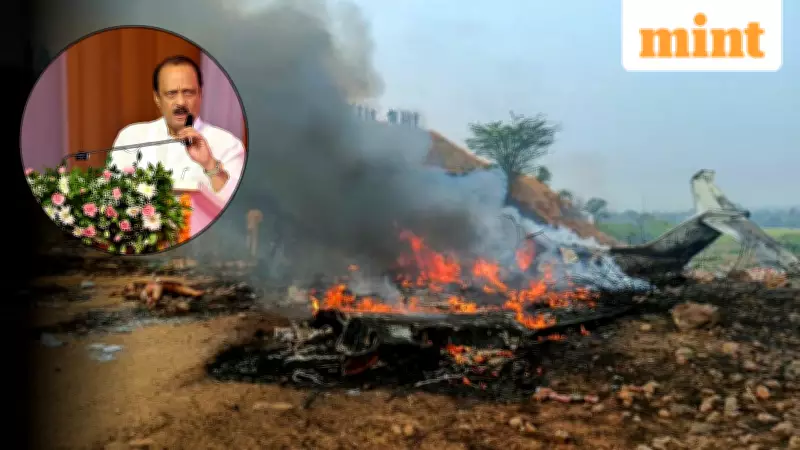
Baramati Plane Crash Investigation Uncovers Chilling Last Words and Airport Safety Concerns
As the investigation into Wednesday's tragic plane crash in Baramati continues, fresh and disturbing details are emerging about the sequence of events that led to the fatal incident which claimed the lives of Maharashtra Deputy Chief Minister Ajit Pawar and four others. The probe into the crash of the Learjet 45 aircraft, operated by VSR Aviation, has taken a significant turn with the revelation of the crew's final communication.
"Oh S**t": The Final Utterance Before Disaster
A senior official from the Directorate General of Civil Aviation (DGCA) has disclosed that the last words captured from the flight crew were an exclamation of "oh s**t." This chilling detail, reported by Hindustan Times, provides a haunting glimpse into the final moments before the aircraft went down. The revelation adds a deeply human and tragic dimension to the ongoing technical and operational investigation.
The Fatal Landing Attempts and Communication Breakdown
The Ministry of Civil Aviation (MoCA), in a detailed release issued late Wednesday, outlined the critical events leading to the crash. According to the ministry, the pilots initially failed to spot the runway at Baramati airport during their first landing attempt. They subsequently initiated a second approach.

During this second attempt, the crew communicated to ground control that the runway was now in sight and received clearance for touchdown. However, mere seconds after this confirmation, the aircraft burst into flames, resulting in the tragic loss of all souls on board. The ministry further noted that pilots Captain Sumit Kapoor and Captain Shambhavi Pathak did not respond to the air traffic control's final landing clearance just before the crash occurred.
Serious Questions Raised About Baramati Airport Infrastructure
The MoCA's statement has cast a harsh spotlight on the operational conditions at the Baramati airport itself. The facility is officially categorized as an "uncontrolled" airport. This classification signifies it possesses only a basic runway and critically lacks both an Air Traffic Control (ATC) tower and a dedicated ATC frequency for professional oversight of landings and takeoffs.
Compounding these concerns, Hindustan Times reported that ground control operations at Baramati are managed by pilot cadets from two private aviation academies located in the town: Redbird Aviation and Carver Aviation. This reliance on trainee personnel for critical ground control functions, at an airport lacking standard ATC infrastructure, is now a central focus of the investigation into whether systemic safety lapses contributed to the disaster.
The emerging narrative paints a picture of a potentially catastrophic combination: a high-stakes landing attempt by experienced pilots, a last-moment realization of impending danger, and an airport environment with significant operational limitations. As the nation mourns the loss of a prominent political figure and his companions, the investigation's findings are poised to trigger a major reassessment of safety protocols at India's smaller and uncontrolled airports.