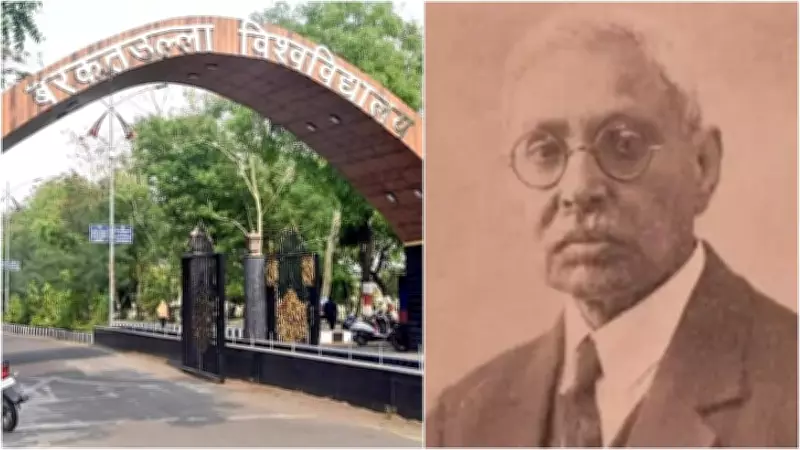
The executive council of Barkatullah University in Bhopal has decided to rename the institution as 'Vagdevi Bhojpal University', a move that has brought the legacy of the freedom fighter Barkatullah back into the spotlight, more than a century after his death. The decision, taken on June 5, 2026, has sparked a fresh debate on the historical recognition of the revolutionary who spent much of his life in exile fighting for India's independence.
Background of the Renaming Decision
Barkatullah University, established in 1970, was named after Maulana Barkatullah, a prominent freedom fighter and pan-Islamist leader from Bhopal. The university's executive council, in its recent meeting, passed a resolution to rename it after the legendary king Raja Bhoj, who is associated with the region's historical and cultural heritage. The new name, 'Vagdevi Bhojpal University', is intended to reflect the local identity and scholarly traditions of the area.
Reactions and Controversy
The proposal has drawn mixed reactions. Supporters argue that Raja Bhoj is a more unifying figure representing the region's glorious past. However, critics view the renaming as an attempt to erase the contributions of Barkatullah, who played a crucial role in the freedom struggle. Barkatullah's descendants and several historians have expressed disappointment, stating that the move undermines the sacrifices of a leader who remains relatively unknown to the younger generation.

Who Was Barkatullah?
Maulana Barkatullah (1854-1927) was a fiery orator and revolutionary who sought support from various countries for India's independence. He was a key figure in the Ghadar Party and even served as the Prime Minister of the Provisional Government of India established in Afghanistan in 1915. Despite his immense contributions, he died in exile in the United States, and his remains were brought back to India only in 1976. The renaming row has reignited interest in his life and work, with many calling for greater recognition of his legacy.
Political Implications
The decision comes amid a broader trend of renaming institutions and landmarks across India, often sparking political debates. In Madhya Pradesh, the ruling party has defended the move as a correction of historical anomalies, while opposition parties have accused it of saffronisation and neglecting the contributions of Muslim freedom fighters. The state government has yet to comment officially on the renaming, but the issue is expected to be a flashpoint in upcoming local elections.
What Happens Next?
The renaming proposal is now subject to approval by the state government and the university's senate. Legal challenges are anticipated, with some groups planning to approach the court to halt the process. Meanwhile, Barkatullah University continues to operate under its original name, but the debate over its identity is far from over. As the centenary of Barkatullah's death approaches in 2027, the controversy underscores the ongoing struggle over how India remembers its freedom fighters.