

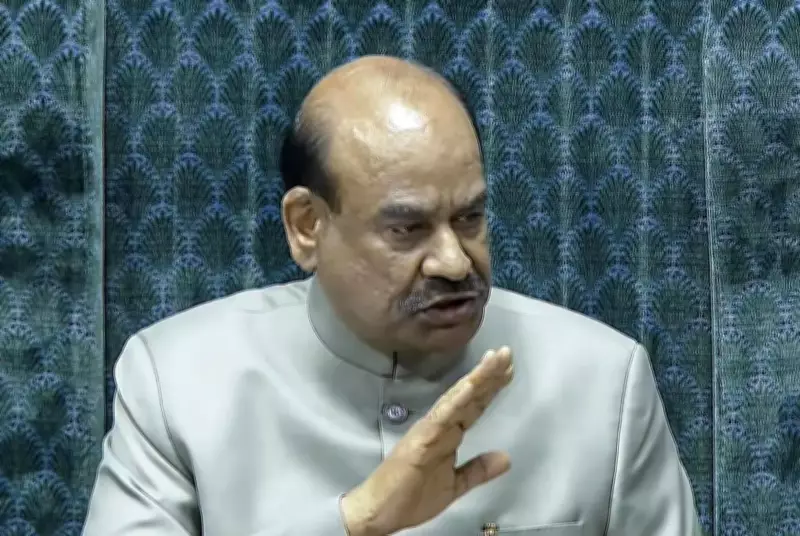
Speaker Om Birla Reveals He Personally Requested PM Modi to Avoid Lok Sabha Reply Over Security Fears
In a dramatic disclosure in the Lok Sabha on Thursday, Speaker Om Birla stated that it was at his specific request that Prime Minister Narendra Modi decided not to come to the House to deliver his reply to the President's address. Birla revealed he had received concrete information that protesting opposition members standing near the Prime Minister's designated seat could potentially pull off some "unexpected act."
Birla Warns of Threat to Democratic Traditions
"Had such an unpleasant act occurred, then its sight would have torn the country's democratic traditions to shreds," Birla asserted amid loud protests from opposition MPs. He emphasized that the entire nation witnessed how some women members had positioned themselves near the PM's seat ahead of his expected arrival on Wednesday, describing their actions as "not in accordance with the House's dignity."
The Prime Minister's scheduled reply to the Motion of Thanks was called off at the last minute on Wednesday due to intense protests from opposition MPs. Many members from Congress and regional parties were raising slogans, partly in response to BJP MP Nishikant Dubey's references to books containing uncharitable remarks about members of the Nehru-Gandhi family.

Parliamentary Proceedings Thwarted and Motion Passed Without PM's Reply
With discussions on the motion already thwarted since Monday over Leader of Opposition Rahul Gandhi's insistence on referencing an unpublished book by former army chief M.M. Naravane—which Birla disallowed—the Lok Sabha ultimately passed the motion through a voice vote without Modi's reply. This marked the first such occurrence since the NDA regime began in 2014, though not without historical precedent.
Birla also expressed strong disapproval of opposition members protesting vocally at his office, an apparent reference to their displeasure over Dubey's speech. He slammed this action as a "black spot" in parliamentary conventions, noting it was unprecedented for MPs to bring political differences to the Speaker's office in such a manner.
Birla Issues Stern Warning to Opposition
The Speaker made it unequivocally clear to the Opposition that the House would not function "either today or tomorrow" if they continued bringing posters and pamphlets inside. He urged them to express their views in alignment with established parliamentary traditions and thanked Prime Minister Modi for accepting his request, which he said was aimed at preserving the dignity of the House.
"It is in no way appropriate that the leader of the House could not speak," Birla stated, underscoring the gravity of the situation.
Congress Dismisses Birla's Claims as "Absolute Lie"
Congress leaders launched a fierce counterattack on Thursday, accusing Prime Minister Modi of seeking cover behind the Speaker and dismissing Birla's statement as an "absolute lie" dictated by the Modi government.
Rahul Gandhi remarked sarcastically, "Modi was so scared of the truth that he sought refuge in lies. Khair, jo uchit samjha, woh kiya"—a Hindi phrase meaning "anyway, he did what he felt appropriate," which was a pointed reference to what General M.M. Naravane described as the PM's stance during the Chinese aggression.
Priyanka Gandhi Vadra questioned the narrative, asking, "They are making the Speaker say all this because yesterday he did not have the guts to come to the house. Because three women were standing in front of his bench?" She asserted there was no question of anyone attempting to harm the Prime Minister, calling the security concerns "an absolute lie."
Historical Precedent Cited in Political Sparring
As the ruling BJP criticized the Opposition for stalling PM Modi's speech, Congress spokesman Jairam Ramesh recalled that on June 10, 2004, then Prime Minister Manmohan Singh was prevented by the BJP from speaking on the Motion of Thanks. Ramesh highlighted Singh's reply on March 10, 2005, where Singh noted he had "waited out an entire year to perform this happy task" and thanked the President for addresses from both 2004 and 2005.

Ramesh stated, "We needed to put it on record that UPA PM Manmohan Singh was not allowed by the BJP to reply to the motion of thanks in 2004 even though the house had concluded the discussion on the motion, and only Singh's reply remained." This historical reference adds another layer to the ongoing political confrontation over parliamentary conduct and traditions.





