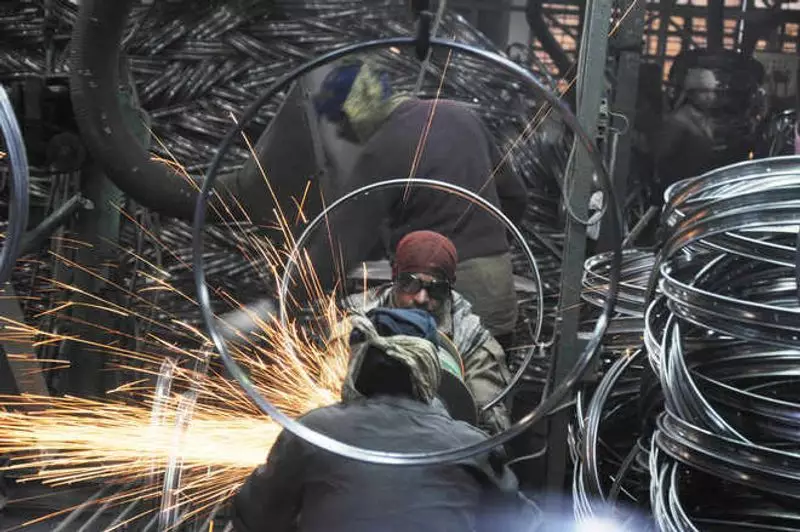
A fresh political controversy has erupted over the state of India's manufacturing sector, with the ruling Bharatiya Janata Party (BJP) and Congress leader Rahul Gandhi trading sharp accusations based on economic data.
The Core of the Controversy
Congress MP Rahul Gandhi recently alleged that India's manufacturing sector has witnessed a significant decline. This claim quickly became a focal point for opposition criticism of the government's economic management. However, the BJP has launched a vigorous counter-offensive, labeling Gandhi's assertion as "fake" and presenting what it says is official data to disprove the charge.
The BJP's national spokesperson, Sambit Patra, spearheaded the party's response. He referenced statistics from the National Statistical Office (NSO) to challenge the narrative. According to the data cited by Patra, the manufacturing sector's contribution to India's Gross Domestic Product (GDP) has actually shown an increase.

What the Numbers Show
The BJP presented figures indicating that the manufacturing sector's share of GDP rose from 15.1% in the 2019-20 fiscal year to 17.4% in the 2023-24 fiscal year. This data point forms the cornerstone of their argument against Rahul Gandhi's claim of a dip. The party accuses the Congress leader of deliberately spreading misinformation to mislead the public and tarnish the image of the Indian economy under Prime Minister Narendra Modi's leadership.
Patra emphasized that the government's policies, such as the Production Linked Incentive (PLI) schemes, have been instrumental in boosting manufacturing. He framed the debate as one between a government focused on "nation-building" and an opposition reliant on "fake news."
Context and Political Repercussions
This exchange is not happening in a vacuum. It is part of a sustained political battle where economic performance is a key battleground. The opposition, led by the Congress, has consistently questioned the government's handling of the economy, pointing to issues like unemployment and inflation. The manufacturing sector, due to its massive employment potential, is a particularly sensitive topic.
By branding Gandhi's claim as false, the BJP aims to project itself as a defender of factual discourse and a competent steward of the economy. The party's strategy involves using official statistical bodies' data to lend credibility to its rebuttal. This incident highlights the growing trend of political disputes increasingly revolving around the interpretation of economic indicators and official data sets.
The war of words is likely to continue, with both sides digging in their heels. The controversy underscores the critical importance of manufacturing in India's economic aspirations and how its performance is interpreted for political messaging. It also puts a spotlight on the challenge for citizens to navigate competing claims backed by selective presentation of data.
As of now, the Congress party has yet to issue a detailed counter-response to the specific data points raised by the BJP spokesperson. The political discourse remains heated, with the truth of economic progress being fiercely contested in the public arena.